Our Grand Mentors are world-renowned musicians who offer their expertise, mentorship, and resources to further the work of our organization. They’ve won Tonys, Grammys, and performed on the world’s biggest stages. We are thankful to have them perform at MMC events, appear on Q&A sessions with our students, offer us tickets to their performances, and much more.
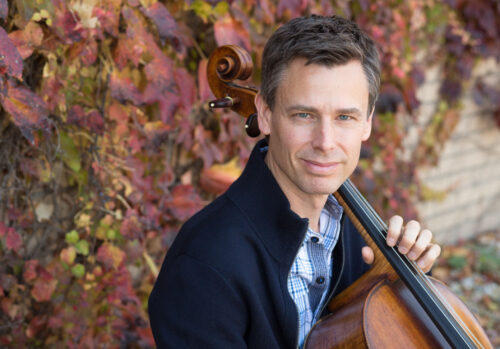
Darrett Adkins (cello)
Darrett Adkins (cello)
Cellist Darrett Adkins was born in Huron, S.D., and has made solo orchestral appearances with the Orchestra of St. Luke’s, Tokyo Philharmonic, New Hampshire Symphony, North Carolina Symphony, Tanglewood Music Center Orchestra, and Monadnock Festival Orchestra. He has also appeared in recital in Tokyo, Yokohama, Oslo, and throughout the U.S. Adkins has been a member of Flux string quartet, which specializes in cutting-edge music, and the Zephyr Trio and was a winner of the Bunkamura Orchard Hall Award and Presser Music Award. His recordings include chamber music on the Koch, CRI, Mode, Tzadic, RCA, and MMC labels.
Adkins has been on the visiting cello faculty at Baylor University since 2001 and is a former faculty member at Encore School for Strings. He holds a BM from Oberlin College, an MM from Rice University, and a DMA from Juilliard, and has studied with Joel Krosnick, Norman Fischer, and Cordelia Wikarski-Miedel. At Juilliard he has been a member of the faculty 2003, assistant faculty from 1999 to 2003, and has taught in Pre-College since 2002.

Emanuel Ax (piano)
Emanuel Ax (piano)
Born to Polish parents in what is today Lviv, Ukraine, Emanuel Ax moved to Winnipeg, Canada, with his family when he was a young boy. Mr. Ax made his New York debut in the Young Concert Artists Series, and in 1974 won the first Arthur Rubinstein International Piano Competition in Tel Aviv. In 1975 he won the Michaels Award of Young Concert Artists, followed four years later by the Avery Fisher Prize.
In recognition of the 50th anniversary of his first appearance with the orchestra, the 2025/26 season begins with the Philadelphia Orchestra in Carnegie Hall on October 31. Fall also includes an Asian tour that will take him to Tokyo, Seoul and Hong Kong. Following the world premiere at Tanglewood in summer 2025, the concerto written for him by John Williams will have its Boston Symphony subscription debut in January with the NY premiere one month later with New York Philharmonic. As a guest artist he will return to orchestras in Dallas, St. Louis, Los Angeles, San Francisco, Pittsburgh, Charleston, Madison, Naples and New Jersey. In recital he can be heard in Philadelphia, Baltimore, Santa Barbara, Des Moines, Cedar Falls, Schenectady and Princeton. An extensive European tour will include concerts in Munich, Prague, Berlin, Rome and Torino.
Mr.Ax has been a Sony Classical exclusive recording artist since 1987 and following the success of the Brahms Trios with Kavakos and Ma, the trio launched an ambitious, multi-year project to record all the Beethoven Trios and Symphonies arranged for trio of which the first three discs have been released. He has received GRAMMY®Awards for the second and third volumes of his cycle of Haydn’s piano sonatas. He has also made a series of GRAMMY-winning recordings with Yo-Yo Ma of the Beethoven and Brahms sonatas for cello and piano. In the 2004/05 season Mr. Ax contributed to an International EMMY®Award-Winning BBC documentary commemorating the Holocaust that aired on the 60th anniversary of the liberation of Auschwitz. In 2013, Mr. Ax’s recording Variations received the Echo Klassik Award for Solo Recording of the Year (19th Century Music/Piano).
Mr. Ax is a Fellow of the American Academy of Arts and Sciences and holds honorary doctorates of music from Skidmore College, New England Conservatory of Music, Yale University, and Columbia University. For more information about Mr. Ax’s career, please visit EmanuelAx.com.

Magdalena Stern-Baczewska (piano)
Magdalena Stern-Baczewska (piano)
Hailed by the press as “One of the most innovative, even radical classical keyboardists in the U.S.” and described as “Columbia University professor by day, musical sorceress by night,” pianist and harpsichordist Magdalena Baczewska [ba-CHEV-ska] enjoys a multifaceted career as a concert artist, educator, and speaker. Having made her solo debut with the Silesian Philharmonic Orchestra at age 12 in her native Poland, Baczewska performed internationally with the world’s leading orchestras.
The first pianist to play J.S. Bach’s Goldberg Variations twice in one evening–first on the harpsichord, then on piano–since Rosalyn Tureck’s 1977 double-bill Carnegie Hall performance, Baczewska has toured Europe and the U.S with double performances of the Variations, having also recorded them along with Strauss’ Sonata Op. 5 for her critically-acclaimed album A Tribute to Glenn Gould.
She collaborates extensively with the Oscar and Grammy Award-winning composer Tan Dun, performing his music internationally. Performance highlights include a debut at the Tanglewood Music Festival, soloist appearances with the San Francisco Symphony, Philadelphia Orchestra, China National Symphony, and a Canadian premiere of Tan Dun’s Piano Concerto with the Vancouver Symphony Orchestra. At the invitation of the composer, Baczewska also recorded his chamber music and the Sonata for Piano Solo in Shanghai’s famous Water Heavens Hall.
Dr. Baczewska is Professor of Music and Director of the Music Performance Program at Columbia University. She is a recipient of the Outstanding Achievement Award from the Polish Minister of Culture and National Heritage, Bogdan Zdrojewski, for promoting Polish culture abroad.
She holds Bachelor’s and Master’s degrees from Mannes College The New School for Music, and a Doctor of Musical Arts degree from Manhattan School of Music. Her doctoral dissertation, In Search of Bach’s Cantabile: The Role and Aspects of Oratory and Singing in Keyboard Interpretation was published by Lambert Academic Publishing.
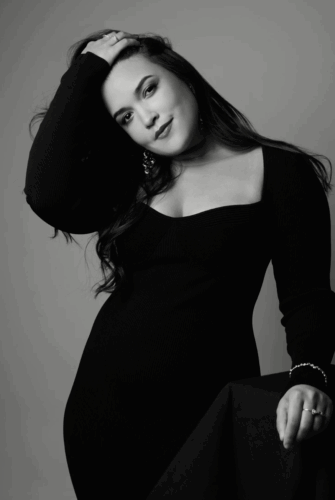
Mikaela Bennett (voice)
Mikaela Bennett (voice)
Mikaela Bennett is a celebrated singer and actress praised for her artistic versatility on stage and in concert halls around the world and is a recent recipient of the Lincoln Center Award for Emerging Artists. Equally at home performing with Gustavo Dudamel and the Los Angeles Philharmonic at Disney Hall or starring in West Side Story (Maria) at the BBC Proms, Mikaela is a skilled interpreter across genres. Additional career highlights include her New York City solo recital debut at Alice Tully Hall; premiering an original composition by Michael Tilson Thomas with the San Francisco Symphony; her Lyric Opera of Kansas City debut in The Sound of Music (Maria); Ricky Ian Gordon’s The Grapes of Wrath (Rosasharn) with MasterVoices at Carnegie Hall; and Handel’s Israel in Egypt with MasterVoices and the Orchestra of St. Luke’s at Carnegie Hall.
In the 25/26 season, Mikaela makes her LA Opera debut in the world premiere of Sarah Kirkland Snider’s Hildegard (Richardis von Stade), followed by a return to the Prototype Festival in the same production—both produced by Beth Morrison Projects. She also returns to Bard SummerScape for the world premiere of Courtney Bryan’s Suddenly Last Summer (Catherine). On the concert stage, she debuts at Emerald City Music in a solo recital featuring the West Coast premiere of a new Molly Joyce song cycle and excerpts from Snider’s Penelope. In December 2025, she appears in Holiday Pops programs with the Grand Rapids, Toronto, and Edmonton Symphony Orchestras.
In the 24/25 season, Mikaela made her debut at Festival Musica Strasbourg in Ted Hearne’s contemporary oratorio The Source. Additional concert appearances included debuts with the Orlando Philharmonic for Mahler’s Symphony No. 4; Kalamazoo Symphony Orchestra in an all-Gershwin program; Kansas City Symphony for their Memorial Day concert Celebrate at the Station; and the Baltimore and Nashville Symphony Orchestras in Mary Lou Williams’ Zodiac Suite with the Aaron Diehl Trio. She also returned to the 92nd Street Y as a guest soloist for Hammerstein and His Sources. Operatic engagements included her debut at the Prototype Festival in In a Grove (Leona Raines/Leona’s Mother) and a return to The Glimmerglass Festival for the world premiere of Derek Bermel and Sandra Cisneros’ The House on Mango Street (Esperanza).
Ms. Bennett made her BBC Proms debut at London’s Royal Albert Hall in the John Wilson Orchestra’s concert production of West Side Story (Maria) to critical and public acclaim, and later returned to perform music from the Warner Bros. film studio with the same orchestra. She appeared as a featured soloist under the baton of Gustavo Dudamel with the Los Angeles Philharmonic performing Wayne Shorter’s Aurora; with the Philadelphia Orchestra under Yannick Nézet-Séguin; with the New York Philharmonic conducted by Leonard Slatkin; and with The Cleveland Orchestra at Blossom Music Center for Zodiac Suite under Jader Bignamini. She also performed with the San Francisco Symphony, National Symphony Orchestra, and New World Symphony—conducted by Michael Tilson Thomas—in the world premiere of his Four Preludes on Playthings of the Wind. Mikaela frequently collaborated with conductor Ted Sperling, including Let ’Em Eat Cake (Mary Wintergreen) at Carnegie Hall with the Orchestra of St. Luke’s. She appeared in Bernstein on Broadway as part of the Leonard Bernstein centennial celebration at the Kennedy Center, directed by Kathleen Marshall and conducted by Rob Fisher. Additionally, she returned to Carnegie Hall with MasterVoices for A Joyful Noise featuring 10-time GRAMMY Award-winning gospel group Take 6.
On stage, Mikaela made her professional debut in The Golden Apple (Penelope) at City Center Encores! She originated the role of Norma in Dick Scanlan and Carmel Dean’s musical Renascence in New York City, and made her Lyric Opera of Chicago debut in Francesca Zambello’s new production of West Side Story (Maria). She also appeared at The Glimmerglass Festival in The Sound of Music (Maria), starred in the title role in Cinderella at The MUNY, and created the title role in Michael Gordon’s Acquanetta, directed by Daniel Fish at the Prototype Festival. Continuing her collaboration with Fish, Ms. Bennett was featured in his concert version of The Most Happy Fella at Bard SummerScape. She made her Festival Napa Valley debut in Gianni Schicchi (Lauretta) under the baton of Kent Nagano. Mikaela also performed in New York’s premier cabaret venues, including Joe’s Pub at The Public and Feinstein’s/54 Below.
Recent highlights included recording Zodiac Suite with Aaron Diehl and The Knights conducted by Eric Jacobsen; returning to MasterVoices for Carmen (Micaëla) at Jazz at Lincoln Center; performing holiday concerts with The Cleveland Orchestra conducted by Brett Mitchell at Severance Hall; and appearing at Caramoor in Over the Rainbow: The Songs of Harold Arlen, conducted by Ted Sperling. She also made debuts with the Oakland Symphony in Zodiac Suite and with the San Diego Symphony in Broadway Romance under Rob Fisher.
Mikaela is a native of Ottawa, Canada, and a graduate of The Juilliard School.

Lizzy Burns (upright bass)
Lizzy Burns (upright bass)
Lizzie Burns is an experienced and sought after bassist and chamber musician who performs in Chamber Orchestras, Continuo Sections, Rhythm Sections, and New Music Ensembles. She has performed with The Chamber Music Society of Lincoln Center, recorded for major Record Labels and Motion Picture Soundtracks, given dozens of World Premieres, is a member of The Knights and A Far Cry, and is on faculty at the Hartt School of Music and the Mannes Conservatory at The New School.
Drawing abundant inspiration from her colleagues, Lizzie works with the International Contemporary Ensemble, Orpheus Chamber Orchestra, St Paul Chamber Orchestra, New Century Chamber Orchestra, East Coast Chamber Orchestra (ECCO), The Orchestra of St Luke’s, and The New York City Ballet Orchestra, in addition to The Knights and A Far Cry. As an experienced historical bassist she has performed with the Handel and Haydn Society, Tafelmusik Baroque, and Teatro Neuovo. She is energized by collaborations with composers and has premiered works by Julia Wolfe, Caroline Shaw, Pauline Oliveros, Andy Akihio, and Jörg Widmann among many others. She played on Broadway in Dave Malloy’s “Natasha, Pierre, and The Great Comet of 1812” alongside Josh Groban. Burns has recorded with soloists Edgar Meyer, Yo-Yo Ma, Gil Shaham, Pekka Kuusisto, Avi Avital and Nicholas Phan. She has performed and/or recorded with popular artists including Jon Batiste, Chris Thile, Phoebe Bridgers, Ingrid Michaelson, Emily King, Wye Oak, and Joe Jackson, as well as making appearances on the Late Show with Stephen Colbert and The Tonight Show with Jimmy Fallon. She has recorded for the Sony Masterworks, Deutsche Grammophon, Naxos, New Amsterdam, and Nonesuch record labels and can be heard on popular film and television soundtracks including HBO’s “Succession”.
As an alum of Ensemble Connect, a rigorous two-year fellowship program based at Carnegie Hall, Lizzie is an experienced Teaching Artist who equally enjoys engaging with audiences from the stage of Carnegie Hall as she does performing in homeless shelters and for incarcerated communities.
Lizzie attended the New England Conservatory and Boston University. Her primary teachers were Don Palma and Ed Barker, to whom she is eternally grateful.
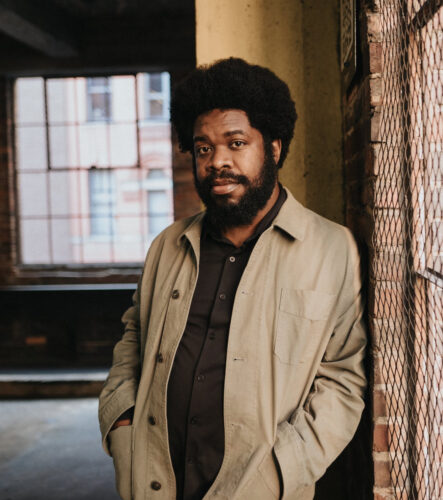
Dashon Burton (voice)
Dashon Burton (voice)
Hailed as an artist “alight with the spirit of the music” (Boston Globe), three-time Grammy Award winning bass-baritone Dashon Burton has established a vibrant career appearing regularly throughout the US and Europe. Highlights of his 2023/24 season include multiple appearances with Michael Tilson Thomas, including a performance of Beethoven’s Symphony No. 9 with the San Francisco Symphony and Copland’s Old American Songs with the New World Symphony. Burton also performs Bach’s Christmas Oratorio with the Washington Bach Consort, sings Handel’s Messiah with the St. Paul Chamber Orchestra and the Philadelphia Orchestra, and performs the title role in Sweeney Todd at Vanderbilt University. With the Cleveland Orchestra, Burton participates in a semi-staged version of Mozart’s The Magic Flute, and he joins the Milwaukee Symphony and Ken-David Masur for three subscription weeks as their Artist-in-Residence.
Last season, Burton returned to the Cleveland Orchestra for Schubert’s Mass No. 6 with Franz Welser-Möst in Cleveland and at Carnegie Hall; to the Houston Symphony for Stravinsky’s Oedipus Rex with Juraj Valčuha; and to the New York Philharmonic for Michael Tilson Thomas’ Meditations on Rilke, led by the composer. Debut appearances included Mendelssohn’s Elijah with the Milwaukee Symphony led by Ken-David Masur, the world premiere of Chris Cerrone’s The Year of Silence with the Louisville Orchestra led by Teddy Abrams, and Dvořák’s Requiem with the Richmond Symphony. In summer 2023, Burton appeared at Tanglewood and Caramoor in critically acclaimed performances of Handel’s Acis and Galatea with Philharmonia Baroque. He continues his relationship with San Francisco Performances as an Artist-in-Residence with appearances at venues and educational institutions throughout the Bay Area.
A multiple award-winning singer, Dashon Burton won his second Grammy Award in March 2021 for Best Classical Solo Vocal Album with his performance featured in Dame Ethyl Smyth’s masterwork The Prison with The Experiential Orchestra (Chandos). As an original member of the groundbreaking vocal ensemble Roomful of Teeth, he won his first Grammy Award in 2013 for their inaugural recording of all new commissions, and his third Grammy Award in 2024 for their most recent recording, Rough Magic, featuring more new commissions from Caroline Shaw, William Brittelle, Peter Shin, and Eve Beglarian.
His other recordings include Songs of Struggle & Redemption: We Shall Overcome (Acis), the Grammy-nominated recording of Paul Moravec’s Sanctuary Road (Naxos); Holocaust, 1944 by Lori Laitman (Acis); and Caroline Shaw’s The Listeners with the Philharmonia Baroque Orchestra. His album of spirituals garnered high praise and was singled out by the New York Times as “profoundly moving…a beautiful and lovable disc.”
Burton received a Bachelor of Music degree from Oberlin College and Conservatory, and a Master of Music degree from Yale University’s Institute of Sacred Music. He is an assistant professor of voice at Vanderbilt University’s Blair School of Music.

Rodger Carter (drums)
Rodger Carter (drums)
Born and raised in Los Angeles, California, Rodger Carter created a path in music from early on. From his first tour with Lita Ford at the age of 21 to his years of studio work and non-stop touring that followed, Rodger’s powerful and consistent style has always kept him working in one of the most competitive cities for music in the world. Rodger has worked with artists Meredith Brooks, Glen Campbell, Justin Guarini, Lisa Loeb, Eddie Money, Rick Springfield, The Temptations, and many more. In 2002, Rodger opened The Doghouse Studio in Los Angeles. When Rodger is not running The Doghouse Studio, he is frequently on the road touring internationally with various artists.

Glen Caruba (drums, percussion)
Glen Caruba (drums, percussion)
Glen Caruba is one of the most in-demand percussionists in the Nashville scene, having recorded or performed with artists such as Jimmy Buffett, Max Carl, Lynda Carter, Beth Nielsen Chapman, Sara Evans, Steve Forbert, Glenn Frey, Vern Gosdin, Jack Jezero, Denny Jiosa, John Jorgensen, Toby Keith, Hal Ketchum, Tom Kimmel, Barry Manilow, The Mavericks, K.T. Oslin, Kenny Rodgers, Lionel Richie, Leon Russell, SheDaisy, Dan Seals, Pam Tillis, Rick Trevino, Kirk Whalum, Lari White, Maurice Williams, Trisha Yearwood amongst many others. His percussion can also be heard on TV commercials and movie soundtracks such as: HBO, Land O Lakes, Pepsi Cola, Coors Light Beer, American Express, Nintendo, King of the Hill, Cape Fear, Contact, and Hope Floats. Glen has three percussion instructional books and videos distributed by Hal Leonard: Afro Cuban Drumming, Modern Percussion Grooves, and The Contemporary Percussionist (DVD).

Victoria Chiang (violin)
Victoria Chiang (violin)
VICTORIA CHIANG is an artist-faculty member of the Peabody Conservatory of Music where she serves as coordinator of the viola department. Her most recent recording of the viola concertos of Stamitz and Hoffmeister was released for Naxos to critical acclaim. Other recordings include Pleyel Sinfonia Concertante for Violin and Viola also on Naxos as well as a recording of Shostakovich and Roslavets Viola sonatas. Career highlights include appearances with the National Philharmonic Orchestra, Romanian State Philharmonics of Constantsa and Tirgu Muresh, Duluth Superior Symphony, the Cincinnati Chamber Orchestra. Baltimore Chamber Orchestra, the Acadiana Symphony and the National Gallery Orchestra in Washington DC. Ms. Chiang has appeared as guest artist with the Guarneri, Takács, Tokyo, American, Arianna and Pro Arte string quartets and is a founding member of the Aspen String Trio, an internationally touring string trio. Ms Chiang spends her summers at the Aspen Music Festival as well as other music festivals, and teaches with Becca Albers at the McDuffie Center.

Dave Dabbon (arranging, composition)
Dave Dabbon (arranging, composition)
David Dabbon is a Broadway/TV/Film composer and arranger. On Broadway, he wrote the medley arrangement for the Broadway and off-broadway production Oh, Mary! by Cole Escola. He has worked as the dance arranger for the Tony-nominated musical adaptation of Beetlejuice, the revival of Funny Girl, and the celebrated musical comedy Disaster! He composed new music and wrote dance arrangements for the revival of Bob Fosse’s Dancin’. He is the arranger and provided musical supervision for the off-broadway musical The Big Gay Jamboree. He also provided additional orchestrations to the Broadway bio-musical Sondheim on Sondheim (Grammy nomination).
For the SNL 50th Homecoming Concert on PeacockTV, David was the music director and co-arranger for the “The Lonely Island Medley” featuring Andy Samberg, Chris Parnell, Jorma Taccone, Bad Bunny, Eddie Vedder, T-Pain and Lady Gaga.
David earned an Emmy nomination for composing the music to the song “Eat Shit, Bob!” which aired on HBO’s award-winning Last Week Tonight with John Oliver. He is a co-composer and music director for actress and comedian, Catherine Cohen’s special Come for Me. David also serves as the music director and arranger for the Las Culturistas Culture Awards with Matt Rogers and Bowen Yang.
David arranged the dance and fight music for the new national touring production of Peter Pan (2024). His dance arranging work can be seen aboard the Disney Dream in Beauty and the Beast.
He had a 12-week run of his interactive game show musical, Game On produced and commissioned by Pittsburgh CLO.
He has an ongoing collaboration with six-time Tony Award winner Audra McDonald, regularly providing orchestrations for her concerts and albums. His work can be heard on both Audra McDonald New York Philharmonic: Sing Happy and Audra McDonald: Go Back Home. His orchestration of the song “Somewhere/Some Other Time” was performed at the 42nd annual Kennedy Center Honors.
He provided arrangements and orchestrations for the HBO documentary Six by Sondheim.
David is also a Usual Suspect at New York Theatre Workshop, ASCAP, and The Society of Composers and Lyricists. He earned a master of music degree in choral conducting from Carnegie Mellon University (under the tutelage of Dr. Robert Page) and a self-defined bachelor of music degree from The Hartt School.
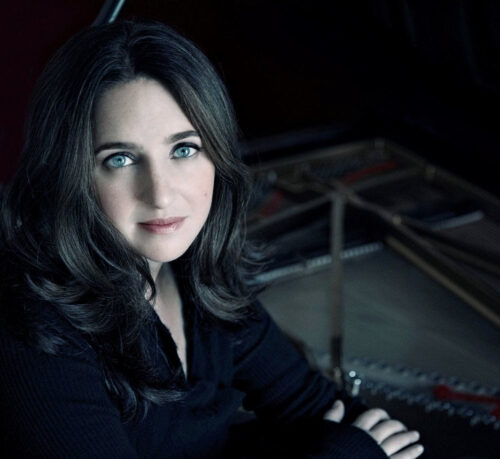
Simone Dinnerstein (piano)
Simone Dinnerstein (piano)
Simone Dinnerstein is an American pianist with a distinctive musical voice. The Washington Post has called her “an artist of strikingly original ideas and irrefutable integrity.” She first came to wider public attention in 2007 through her recording of Bach’s Goldberg Variations, reflecting an aesthetic that was both deeply rooted in the score and profoundly idiosyncratic. She is, wrote The New York Times, “a unique voice in the forest of Bach interpretation.”
Since that recording, she has had a busy performing career. She has played with orchestras ranging from the New York Philharmonic and the Montreal Symphony Orchestra to the London Symphony Orchestra and the Orchestra Sinfonica Nazionale Rai. She has performed in venues from Carnegie Hall and the Kennedy Center to the Berlin Philharmonie, the Vienna Konzerthaus, the Seoul Arts Center and the Sydney Opera House.
Simone has made thirteen albums, all of which topped the Billboard classical charts and were recorded by Grammy Award-winning producer Adam Abeshouse, with repertoire ranging from Couperin to Glass. From 2020 to 2022, she released a trilogy of albums recorded at her home in Brooklyn during the pandemic. A Character of Quiet (Orange Mountain Music, 2020), featuring the music of Philip Glass and Schubert, was described by NPR as, “music that speaks to a sense of the world slowing down,” and by The New Yorker as, “a reminder that quiet can contain multitudes.” Richard Danielpour’s An American Mosaic (Supertrain Records, 2021), surpassed two million streams on Apple Music and was nominated for a 2021 Grammy Award in the category of Best Classical Instrumental Solo. The final installment in the trilogy, Undersong, was released in January 2022 on Orange Mountain Music.
In recent years, Simone has created projects that express her broad musical interests. She gave the world premiere of The Eye Is the First Circle at Montclair State University, the first multi-media production she conceived, created, and directed, which uses as source materials her father Simon Dinnerstein’s painting The Fulbright Triptych and Charles Ives’s Piano Sonata No. 2. She premiered Richard Danielpour’s An American Mosaic, a tribute to those affected by the pandemic, in a performance on multiple pianos throughout Brooklyn’s Green-Wood Cemetery. Following her recording, Mozart in Havana, she brought the Havana Lyceum Orchestra from Cuba to the U.S. for the first time, performing eleven concerts. Philip Glass composed his Piano Concerto No. 3 for her, co-commissioned by twelve orchestras. Working with Renée Fleming and the Emerson String Quartet, she premiered André Previn and Tom Stoppard’s Penelope at the Tanglewood, Ravinia and Aspen music festivals, and performed it at Carnegie Hall, the Kennedy Center, and presented by LA Opera and the Cleveland Orchestra. In New York, she regularly curates and performs on an innovative Bach series at the Miller Theatre, and this season she is an Artist-in-Residence at the Kaufman Music Center, where she will mentor student musicians and perform Philip Glass’s The Hours and Tirol piano concerto with the Brooklyn Orchestra. She has also created her own ensemble, Baroklyn, which she directs from the keyboard.
Simone is committed to giving concerts in non-traditional venues and to audiences who don’t often hear classical music. For the last three decades, she has played concerts throughout the United States for the Piatigorsky Foundation, an organization dedicated to the widespread dissemination of classical music. It was for the Piatigorsky Foundation that she gave the first piano recital in the Louisiana state prison system at the Avoyelles Correctional Center. She has also performed at the Maryland Correctional Institution for Women in a concert organized by the Baltimore Symphony Orchestra. In 2009, Simone founded Neighborhood Classics, a concert series open to the public and hosted by New York City Public Schools to raise funds for their music education programs. She also created a program called Bachpacking during which she brought a digital keyboard to elementary school classrooms, helping young children get close to the music she loves. She is a committed supporter and proud alumna of Philadelphia’s Astral Artists, which supports young performers. Simone is on the piano faculty of the Mannes School of Music and is a guest host/producer of WQXR’s Young Artists Showcase.
Simone counts herself fortunate to have studied with three unique artists: Solomon Mikowsky, Maria Curcio and Peter Serkin, very different musicians who shared the belief that playing the piano is a means to something greater. The Washington Post comments that “ultimately, it is Dinnerstein’s unreserved identification with every note she plays that makes her performance so spellbinding.” In a world where music is everywhere, she hopes that it can still be transformative.

Jocelyn Dueck (piano, voice)
Jocelyn Dueck (piano, voice)
Pianist Jocelyn Dueck is widely known for her interpretations of new music, premiering and commissioning works by composers Lembit Beecher, Lisa Bielawa, Tom Cipullo, Conrad Cummings, Daniel Felsenfeld, Libby Larsen, Judd Greenstein, John Glover, Daron Hagen, Gabriel Kahane, Gilda Lyons, Robert Paterson, Kevin Puts, Matthew Schickele and Gregory Spears, to name a few. Jocelyn was a collaborator on the Billboard Chart-topper Five Borough Songbook, a seminal collection of songs by New York City’s most innovative composers as well as the second volume of the songbook in January of 2017.
Jocelyn’s recording of Matthew Schickele’s solo and four-hands piano music marked four decades of duet playing with her brother, Byron Dueck. Her joint album Love. Sex. Death explores cabaret music by “serious” composers,” including Poulenc, Bolcom and Schoenberg, and features chanteuse/raconteuse Sarah Chalfy. Durey Rediscovered highlights forty-one previously unrecorded songs by Louis Durey, collected in manuscript form from the Durey family by Jocelyn over a fourteen year period.
Jocelyn is an Assistant Professor of Collaborative Arts at Carnegie Mellon University, and a subject matter expert in prosody and related auditory coding and data structure. She has a distinguished record of achievement as a practitioner in linguistics, music and language translation. Jocelyn has over thirty years’ experience coaching and training others to reproduce and codify sound units, with experience in at least four different languages and multiple English language accents and dialects. She is honored to be a part of Adobe’s Readability Matters consortium, founded by the University of Central Florida and Readability Matters, with a goal of improving reading for all.
Dr. Dueck recently founded Courante LLC, a company dedicated to reproducing flow states. Courante analyzes prosody and phrasing, enabling humans and machines to read language and music more fluently.
Jocelyn holds a doctorate in Collaborative Piano, achieved under the expert guidance of Margo Garrett and Karl Paulnack. Her studies with Phillip Moll in Berlin were central to her understanding of score study, pianism and artistry. Recital tours have taken her across the United States, Europe and China. Honors and awards include grants from the Classical Recording Foundation, Brooklyn Arts Council, Meet the Composer MetLife Creative Connections, American Composers Forum Encore, a Tanglewood Music Center Fellowship, and a Canadian Department of Foreign Affairs and International Trade grant with her pianist sibling trio, Dueck Three for their concert tour of China.
Capable of breadth and depth in characterizing the sound units across languages, Jocelyn has served on the faculties of Juilliard, Bard, MSM, Mannes and NYU. Opera credits include the Lindemann Young Artist Program at the Metropolitan Opera, Glimmerglass Opera and Seattle Opera. Since 2019, she has been on the music staff at Wolf Trap Opera where she prepares language and coaches Filene and Studio artists in general operatic repertoire. Having experienced a watershed moment as a fellow at Tanglewood in 2004, Jocelyn is delighted to return there in the summer of 2023 as faculty. Jocelyn thinks of herself as a professional listener, and is in relentless pursuit of new ways to analyze and describe the things she hears.

Pete Eddins (composition, piano, woodwinds)
Pete Eddins (composition, piano, woodwinds)
Pete Eddins is a multi-instrumentalist, producer, and composer. He works across many genres including hip-hop, pop, R&B, rock, folk, and jazz. With a background in classical composition and orchestration and film scoring, Peter received his Masters Degree from Berklee in scoring for film, TV, and video game. He recorded and conducted a full orchestra at Abbey Road Studios in 2015 and has worked with DJ Khaled, Drake, Adia Victoria, Aaron Dessner (The National, Taylor Swift, Bon Ives) and many others. Originally from Kansas City, MO, Peter is now based out of Nashville, TN.

Aaron English (piano, songwriting, voice)
Aaron English (piano, songwriting, voice)
Nashville-based singer-songwriter/pianist Aaron English’s soul-searching songs are soulful, sophisticated, cinematic…and filled with echoes of his travels through Africa, Brazil and the Middle East.
Aaron’s music has been featured on the TV show “Bones,” as well as a Top 5 radio hit in Italy, Top 20 radio hit in the U.S., two hits in Pakistan. He has also been named a Keyboard Magazine “Artist to Watch”. His music has been heard on CBS, NBC, Bravo and TBS, The Daily Show with Trevor Noah, and ads for Google, Chevrolet, Motorola, Patagonia, Kaiser Permanente, Price Waterhouse Cooper and Kraft Foods.
In 2015 Aaron spent two months in East Africa, where he founded the International Youth Music Project, a charity that supports youth music programs at orphanages, refugee camps and HIV/AIDS+ community centers.
In 2023 Aaron travelled to Karachi, Pakistan, where he played concerts and wrote music with Pakistani artists. The trip culminated in the climate change anthem “Sound the Alarm”, Aaron’s collaboration with the U.S. State Department and hip-hop star Ali Gul Pir.
In 2025, Aaron was a recipient of the Beyond Music Foundation’s Social Activist Award for his “exceptional commitment to social causes” as founder/director of the International Youth Music Project.
Aaron divides his time between touring in the U.S. and Europe, his charity efforts in Africa, livestream concerts on StageIt.com, and long-distance collaborations with musicians around the world.

Christine Goerke (voice)
Christine Goerke (voice)
Soprano Christine Goerke has appeared in the major opera houses of the world including the Metropolitan Opera, Lyric Opera of Chicago, San Francisco Opera, Santa Fe Opera, Washington National Opera, Houston Grand Opera, Seattle Opera, Opera Company of Philadelphia, Pittsburgh Opera , New York City Opera, Glimmerglass Opera, Royal Opera House Covent Garden, Paris Opera, Théâtre du Châtelet, Théâtre du Capitole in Toulouse, Deutsche Oper Berlin, La Scala, Maggio Musicale Fiorentino, Teatro Real in Madrid, Teatro Municipal de Santiago, and the Saito Kinen Festival. She has sung much of the great soprano repertoire, starting with the Mozartand Handel heroines and now earning critical acclaim for the dramatic Strauss and Wagner roles. She has received praise for her portrayals of the title roles in Elektra, Turandot, and Ariadne auf Naxos, Brünnhilde in the Ring Cycle, Kundry in Parsifal, Ortrud in Lohengrin, Leonora in Fidelio, Eboli in Don Carlos, The Dyer’s Wife in Die Frau ohne Schatten, Cassandre in Les Troyens, Ellen Orford in Peter Grimes, Female Chorus in The Rape of Lucretia, Alice in Falstaff, and Madame Lidoine in Dialogues des Carmelites.
Ms. Goerke has also appeared with a number of the leading orchestras including the New York Philharmonic Orchestra, Boston Symphony Orchestra (in Boston, Carnegie Hall, and the Tanglewood Festival), Chicago Symphony Orchestra, Cleveland Orchestra, Los Angeles Philharmonic, National Symphony Orchestra, Radio Vara (at the Concertgebouw), Sydney Symphony, New Zealand Symphony, the Orchestra of the Age of Enlightenment, the BBC Symphony Orchestra at the BBC Proms, and the Hallé Orchestra at the Edinburgh International Festival. She has worked with some of the world’s foremost conductors including James Conlon, Sir Andrew Davies, Sir Mark Elder, Christoph Eschenbach, Claus Peter Flor, James Levine, Sir Charles Mackerras, Kurt Masur, Zubin Mehta, Andris Nelsons, Seiji Ozawa, David Robertson, Donald Runnicles, Esa-Pekka Salonen, the late Robert Shaw, Patrick Summers, Jeffery Tate, Christian Thielemann, Michael Tilson Thomas, and Edo de Waart.
Ms. Goerke’s recording of Vaughan Williams’ A Sea Symphony with Robert Spano and the Atlanta Symphony Orchestra won the 2003 Grammy Award for Best Classical Recording and Best Choral Performance. Her close association with Robert Shaw yielded several recordings including Brahms’ Liebeslieder Waltzes, Poulenc’s Stabat Mater, Szymanowski’s Stabat Mater, and the Grammy-nominated recording of Dvorak’s Stabat Mater. Other recordings include the title role in Iphigenie en Tauride for Telarc and Britten’s War Requiem, which won the 1999 Grammy Award for Best Choral Performance.
This season, Ms. Goerke returns to the Metropolitan Opera for Turandot, the Houston Grand Opera for Les Dialogues des Carmelites, and to the Opéra National de Paris for Elektra. She also appears in concert with the Bayreuther Festspielorchester on a European tour, and with the Baltimore Symphony.
Ms. Goerke was the recipient of the 2001 Richard Tucker Award, the 2015 MusicalAmerica Vocalist of the Year
Award, and the 2017 Opera News Award.

Cliff Goldmacher (multi-instrumentalist, production, songwriting)
Cliff Goldmacher (multi-instrumentalist, production, songwriting)
In the music business for over thirty years, Cliff Goldmacher is a GRAMMY- recognized, #1 hit songwriter, producer, author and owner of recording studios in
Nashville, Tennessee and Middle River, Maryland. A multi-instrumentalist and session musician, Cliff has recorded, played on and produced thousands of recordings for major and independent publishers, record labels, from up and coming songwriters to GRAMMY winners. Cliff worked as a staff songwriter on Nashville’s Music Row and his songwriting collaborators include multi-platinum selling and GRAMMY-winning artists Ke$ha, Keb’ Mo’, Mickey Hart (Grateful Dead), Chris Barron (Spin Doctors) & Lisa Loeb. Cliff’s songs have been recorded by major label artists in genres ranging from country, pop, blues and jazz to classical crossover. His music has also been used on NPR’s “This American Life” and in national advertising campaigns. Along with multiple songs in the top 40 on the jazz charts, Cliff’s song “Till You Come To Me,” went to #1. Most recently, Cliff’s song “Cold Outside” – a collaboration with Keb’ Mo’ – was included on Keb’ Mo’s GRAMMY-winning album, “Oklahoma.” As an educator, Cliff teaches workshops for BMI, ASCAP, The Stanford Jazz Workshop, The Recording Academy, The Songwriter’s Guild of America and the
Nashville Songwriter’s Association International (NSAI). Cliff also served as a multi- term governor on the San Francisco Board of the Recording Academy.
Cliff’s book, The Reason for the Rhymes, explores how learning to write songs can not only enhance creativity and problem-solving skills but also improve the ability to innovate.

Giancarlo Guerrero (conducting)
Giancarlo Guerrero (conducting)
Giancarlo Guerrero is a six-time GRAMMY® Award-winning conductor, Music Director of the Nashville Symphony and NFM Wrocław Philharmonic and Principal Guest Conductor of the Gulbenkian Orchestra in Lisbon. Guerrero has been praised for his “charismatic conducting and attention to detail” (Seattle Times) in “viscerally powerful performances” (Boston Globe) that are “at once vigorous, passionate, and nuanced” (BachTrack).
Maestro Guerrero has appeared with prominent North American orchestras, including those of Baltimore, Cincinnati, Chicago, Cleveland, Dallas, Detroit, Indianapolis, Los Angeles, Milwaukee, Montréal, Philadelphia, Seattle, Toronto, Vancouver, and the National Symphony Orchestra. Internationally he has worked in recent seasons with the Frankfurt Radio Symphony, Brussels Philharmonic, Deutsches Radio Philharmonie, Orchestre Philharmonique de Radio France, Netherlands Philharmonic, Residentie Orkest, NDR in Hannover, Orquesta Sinfónica de Galicia and the London Philharmonic Orchestra, as well as the Queensland Symphony and Sydney Symphony in Australia. Guerrero was honored as the keynote speaker at the 2019 League of American Orchestras conference.
Born in Nicaragua, Guerrero immigrated during his childhood to Costa Rica, where he joined the local youth symphony. He studied percussion and conducting at Baylor University in Texas and earned his master’s degree in conducting at Northwestern. Given his beginnings in civic youth orchestras, Guerrero is particularly engaged with conducting training orchestras and has worked with the Curtis School of Music, Colburn School in Los Angeles, National Youth Orchestra (NYO2) and Yale Philharmonia, as well as with the Nashville Symphony’s Accelerando program, which provides an intensive music education to promising young students from diverse ethnic backgrounds.
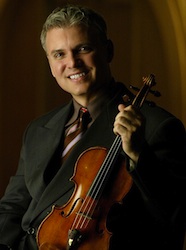
David Halen (violin)
David Halen (violin)
David Halen, concertmaster of the St. Louis Symphony (SLS), is professor of violin in the Department of Strings at the University of Michigan. Halen earned a BM from Central Missouri State University and an MM from the University of Illinois at Urbana-Champaign where he studied with the late Sergiu Luca. He joined the SLS in 1991 and was named concertmaster in September 1995, serving under music directors Leonard Slatkin, the late Hans Vonk and, currently, David Robertson. He has soloed with the orchestra in many of the major concerti in the violin repertoire and has also soloed with the Houston, San Francisco and West German Radio (Cologne) Symphonies. Prior to joining the SLS, Halen was assistant concertmaster with the Houston Symphony Orchestra.
Born in Bellevue, Ohio, Halen grew up in Warrensburg, Missouri. His father, the late Walter J. Halen, was also his violin professor at Central Missouri State University, where Halen earned his bachelor’s degree at the age of 19. In that same year, he won the Music Teachers’ National Association Competition and was granted a Fulbright scholarship for study with Wolfgang Marschner at the Freiburg Hochschule für Musik in Germany, the youngest recipient ever to have been honored with this prestigious award.
During the summer, Halen teaches and performs extensively, serving as concertmaster at the Aspen Music Festival and School under Robert Spano. He has also soloed, taught, and served as concertmaster extensively at the Orford Arts Centre in Quebec, the Manhattan School of Music, Indiana University, the National Orchestra Institute at the University of Maryland, the Academy of the West in Santa Barbara, and the New World Symphony in Miami Beach. In 2007 he was appointed Distinguished Visiting Artist at Yale University and at the new Robert Mcduffie Center for Strings at Mercer University in Macon Georgia.
As co-founder and artistic director of the Innsbrook Institute, Halen coordinates a week-long festival each June, creating exciting musical performances and an enclave for aspiring artists. In August, he is artistic director of the Missouri River Festival of the Arts held in one of the oldest opera houses in the mid-United States in Boonville, Missouri. His numerous accolades include the 2002 St. Louis Arts and Entertainment Award for Excellence, and honorary doctorates from Central Missouri State University and from the University of Missouri – Saint Louis.

Joel Harrison (composition, guitar)
Joel Harrison (composition, guitar)
Guitarist, composer, arranger, lyricist, writer, educator, and vocalist Joel Harrison has “created a new blueprint for jazz” (New Orleans Times-Picayune). A Guggenheim Fellow (2010) whose compositions have been commissioned by Chamber Music America, Meet the Composer, New Music USA, the Jerome Foundation, NYSCA, and the Mary Flagler Cary Trust, Harrison is a two-time winner of the Jazz Composers Alliance Composition Competition and has appeared repeatedly on DownBeat Magazine’s “Rising Star” poll.
His twenty-five releases as a leader showcase his prowess as a shapeshifting composer, with works for orchestra, string quartet, solo cello, and percussion as well as the PASIC award-winning marimba solo Fear of Silence. Notable releases include Free Country, featuring Norah Jones and David Binney; the recent America at War for jazz orchestra; String Choir: The Music of Paul Motian; and Search, featuring Donny McCaslin. His ever-surprising body of work seamlessly connects multiple American traditions. Harrison’s music may be founded on jazz but veers into classical, rock, country, and all manner of American roots music. Succinctly described by the New York Times as “protean… brilliant,” he is also an active film composer, having worked on the Oscar-nominated Traffic Stop and the Sundance awardee Southern Comfort.
A former student of Jimmy Wyble and Mick Goodrick, Harrison is the founder and director of the Alternative Guitar Summit, a yearly festival devoted to new and unusual guitar music. The festival has featured such artists as Fred Frith, Nels Cline, Bill Frisell, Julian Lage, and Pat Metheny, who has called the Summit “one of the most interesting and distinguished forums for guitar on the planet.”

Myra Huang (piano)
Myra Huang (piano)
Acclaimed by Opera News as being “among the top accompanists of her generation,” and “…a colouristic tour de force” by The New York Times, Grammy® Award-nominated pianist Myra Huang is highly sought after for her interpretation of lieder and art song as well as her depth of musicianship and impeccable technique. Huang is invited regularly to perform around the world, with tours including regular appearances at Carnegie Hall, Wigmore Hall, The Mostly Mozart Festival at Lincoln Center, The Walt Disney Concert Hall in Los Angeles, The Kennedy Center, and The 92nd Street Y.
Huang was chosen as the recipient of The Samuel Sanders Collaborative Artist Award for 2019 by The Classical Recording Foundation for her consummate artistry. Regular collaborations include recitals with Fleur Barron, J’Nai Bridges, Lawrence Brownlee, Sasha Cooke, Ying Fang, Joshua Hopkins, Will Liverman, Angela Meade, John Matthew Myers, Eric Owens, Nicholas Phan, Susanna Phillips, Roderick Williams, and clarinetist Anthony McGill.
Huang holds the positions of the Head of Music for the Lindemann Young Artist Development Program at The Metropolitan Opera, The Director of Musical Administration and Head Coach at The Aspen Music Festival, and faculty of the Collaborative Piano Department at The Manhattan School of Music, where she mentors and supports young opera singers and pianists of the next generation.
Huang is an avid recitalist and recording artist. She is a two-time Grammy nominee for her albums Gods and Monsters and Clairières with tenor Nicholas Phan on the Avie label. Huang is a Steinway Artist.

Dave Jacques (bass)
Dave Jacques (bass)
Dave Jacques toured with John Prine for twenty-five years. His distinctive bass playing can be heard on John’s “The Tree of Forgiveness” and Grammy Award-winning “Fair and Square,” as well as on “For Better, Or Worse,” “In Person & On Stage,” “Standard Songs for Average People,” “Souvenirs,” “In Spite of Ourselves” and “Live on Tour.”
In addition to his work with John, Dave has toured and/or recorded with Emmylou Harris, Buddy Miller, Daddy, Iris Dement, Steve Forbert, Patty Griffin, Lucinda Williams, Greg Brown, Rodney Crowell, Kevin Gordon, Jason Wilber, Jimmy Rankin, Jeff Black, Greg Trooper, Todd Snider, and many more.

Gabriel Kahane (composition, piano)
Gabriel Kahane (composition, piano)
Gabriel Kahane is a musician, writer, and storyteller.
Highlights of the 25/26 season include collaborations with Roomful of Teeth and Attacca Quartet; conducting debuts with Santa Fe Pro Music and the San Antonio Philharmonic; the world premiere of a new set of songs at the 92nd Street Y; the Carnegie Hall premiere of If love will not swing wide the gates, a clarinet concerto written for Anthony McGill; and the release on Nonesuch Records of Heirloom, a piano concerto written for Jeffrey Kahane, who is, not coincidentally, Gabriel’s father. That work, recorded with The Knights and conductor Eric Jacobsen, has been heard widely throughout the United States since its premiere in September of 2021.
An avid theater artist, Kahane opened last season at Playwrights Horizons with the off-Broadway debut of two solo pieces, Magnificent Bird and Book of Travelers, the latter of which chronicled the composer’s 8,980-mile railway journey in the aftermath of the 2016 presidential election. His album & stage spectacle, The Ambassador, was produced at the BAM Next Wave Festival in 2014, under the direction of Tony-winner John Tiffany. A musical, February House, written with the playwright Seth Bockley, received its New York premiere at the Public Theater in 2012. In 2018, Kahane made his Broadway debut with the score for Kenneth Lonergan’s play The Waverly Gallery, starring Elaine May, Lucas Hedges, and Michael Cera.
Kahane is known for tackling politically thorny subject matter in his work with subtlety and grace, perhaps most notably in his orchestral oratorio, emergency shelter intake form, which addresses economic inequality through the lens of homelessness and housing insecurity, and has been heard from London to New York to Chicago to San Francisco and beyond. He is also increasingly productive as a writer, with prose appearing in The Atlantic, The New Yorker, and The New York Times. Via the newsletter “Words and Music,” Kahane publishes bi-weekly essays on a variety of topics, all of which can be accessed at gabrielkahane.substack.com.
Gabriel’s wide-ranging discography includes five albums as a singer-songwriter, several orchestral projects, a disc of chamber music (with the string quartet Brooklyn Rider), as well as various other collaborative albums. He has worked with an array of artists spanning the aesthetic gamut, from Phoebe Bridgers, Paul Simon, Sylvan Esso, Chris Thile, and Sufjan Stevens, to the Danish String Quartet, Caroline Shaw, and Pekka Kuusisto, with whom he plays as the duo Council. The recipient of a 2021 Charles Ives Fellowship from the American Academy of Arts and Letters, Kahane relocated to Portland, Oregon, in the spring of 2020, where he lives with his family and serves as Creative Chair of the Oregon Symphony, a post he has held since 2019.

Fats Kaplin (multi-instrumentalist)
Fats Kaplin (multi-instrumentalist)
Fats Kaplin is a renowned multi-instrumentalist based in Nashville, Tennessee. Originally from New York City, Fats performs regularly on mandolin, pedal steel, violin, and numerous other string instruments. He has worked with world-famous musicians including Jack White, Mitski, and Buddy Miller, among many others. He has performed all over the world, including at renowned American venues such as the Hollywood Bowl, Radio City, and Red Rocks.

Ida Kavafian (violin)
Ida Kavafian (violin)
Internationally acclaimed as a violist as well as violinist, the versatile Ida Kavafian is an artist-member of the Chamber Music Society of Lincoln Center and former violinist of the Beaux Arts Trio. For 34 years she has been artistic director of Music from Angel Fire in New Mexico, where some 200 Curtis students have participated in the Young Artist Program to date. She was a founder of the Bravo! Colorado festival, serving as its artistic director for ten years; and co-founded the chamber ensembles Opus One, Tashi, and Trio Valtorna. She also performs as a soloist and in recital with her sister, violinist Ani Kavafian.
Ms. Kavafian has premiered numerous works, including concertos by Toru Takemitsu and Michael Daugherty, whose Fire and Blood she recorded with the Detroit Symphony. She has toured and recorded with jazz artists Chick Corea and Wynton Marsalis, and with fiddler/composer Mark O’Connor.
Born in Istanbul of Armenian parentage, Ms. Kavafian is a graduate of the Juilliard School, where she studied with Oscar Shumsky. She made her debut through Young Concert Artists with the pianist Peter Serkin, and also received the coveted Avery Fisher Career Grant. She resides with her husband, violist Steven Tenenbom, in Philadelphia and Connecticut, where they breed and train prizewinning Hungarian vizsla show dogs.
Since 1998 Ms. Kavafian has served on the faculty of the Curtis Institute of Music, where she received the 2013 Lindback Foundation Award for Distinguished Teaching. She also teaches at the Juilliard School and the Bard College Conservatory of Music.

Alan R. Kay (clarinet)
Alan R. Kay (clarinet)
Alan R. Kay is Co-Principal Clarinetist and a former Artistic Director of Orpheus Chamber Orchestra and serves as Principal Clarinet with New York’s Riverside Symphony and the Little Orchestra Society. He also performs as principal with the American Symphony and the Orchestra of St. Luke’s. Mr. Kay’s honors include the C.D. Jackson Award at Tanglewood, a Presidential Scholars Teacher Recognition Award, Juilliard’s 1980 Competition, and the 1989 Young Concert Artists Award with the sextet Hexagon later featured in the prizewinning documentary film, “Debut.” Mr. Kay is a founding member of Windscape and Hexagon; he appears regularly with the Chamber Music Society of Lincoln Center.
His summer festivals include the Yellow Barn and Skaneateles Festivals, and his innovative programming for the New York Chamber Ensemble is a feature of the Cape May Music Festival. Mr. Kay taught at the Summer Music Academy in Leipzig, Germany in 2004 and teaches at the Manhattan School of Music, The Juilliard School and Stony Brook University.
He has served on the juries of the International Chamber Music Festival in Trapani, Italy, Young Concert Artists International Auditions, and the Fischoff Chamber Music Competition. A virtuoso of wind repertoire, Mr. Kay has recorded with Hexagon, Windscape, the Sylvan Winds, Orpheus and numerous other ensembles. His arrangements for wind quintet are available at Trevco Music Publishing and International Opus.

Karen Ann Krieger (piano)
Karen Ann Krieger (piano)
Karen Ann Krieger served as collegiate piano chair at the Blair School of Music. Before she joined Vanderbilt in 1988, she was assistant professor of piano at Columbus State University in Georgia. Krieger also gained recognition as an award-winning television news director, news and weather anchor, photographer and producer at TV stations in Columbus, Georgia, and Nashville. Her most memorable experiences include covering Presidents Ronald Reagan and Jimmy Carter, along with a performance for President Carter and with the Gregg Allman Band. Her music-related interviews include Gregg Allman, Emmylou Harris, Bruce Hornsby, Billy Joel, Dr. John, Al Kooper, Chuck Leavell, Michael McDonald, Steve Winwood, and Reese Wynans.
Recognized as a performer and teacher, Krieger has given more than 100 workshops and concerts worldwide, including British Columbia, Cyprus, Great Britain, Italy, Spain and the former Yugoslavia. She is widely recognized for her presentations, performances and leadership at the National Conference on Keyboard Pedagogy, the World Piano Pedagogy Conference, and the Music Teachers National Association Conference.
Krieger has performed on both piano and accordion with the Nashville Symphony and on National Public Radio. Under the auspices of New York’s Columbia Artists and Allied Artists, she performed on both instruments across the United States with saxophonist Neal Ramsay.
She is the author of student solo and duet compositions and books on blues and rock ’n’ roll published by Alfred Music and FJH Music. Her keyboard harmony textbook, Group Piano: Proficiency in Theory and Performance, is a 2019 Hal Leonard publication. Krieger’s students have won and placed in local, state and national competitions in piano performance and composition, and many former students lead successful university teaching and performing careers.
“Make music, have fun, and remember it’s not about you, it’s about the music—make ’em listen, and you can’t go wrong” is Krieger’s oft-repeated mantra. Krieger is from the southside of Chicago and has a twin brother. She credits her teaching success to a well-rounded education at Western Illinois University where she earned a B.A. in piano performance with a minor in business, and an M.M. in piano performance at the University of Illinois. Her professors and mentors include William Heiles, James Lyke, Roger Shields, Kenneth Drake, Tony Caramia, Ann Collins, James Magsig, Robert Hills, and Elizabeth Cormier.

Carla LaRocca (piano)
Carla LaRocca (piano)
Carla LaRocca is a native of Ann Arbor, Michigan, where she began her musical studies at the age of six with her father, Anthony LaRocca, a former New Orleans jazz pianist. She later studied with Natalie Matovinovic, Charles Fisher, Laura Kargul, and Nelson Whitaker. Ms. LaRocca holds a B.A. from Albion College (summa cum laude) and an M.F.A. with honors from Carnegie Mellon University. LaRocca was the pianist of the Ann Arbor Symphony and has appeared as a soloist and chamber musician throughout the United States and Europe. She has performed for Norman Dello Joio and was honored to play for the Italian Ambassador of Italy. Currently, Ms. LaRocca is the Choir Director for St. Mary Magdalene Parish.
Carla LaRocca is Associate Teaching Professor of Keyboard Studies at Carnegie Mellon University. She has taught nearly every music major since she joined the faculty in the School of Music since 1989. LaRocca is also the Director of Beginning Piano in the Carnegie Mellon Preparatory School.
Carla LaRocca was awarded by Carnegie Mellon University with the prestigious Henry Hornbostel Teaching Award in 2020.

Adam Levy (guitar)
Adam Levy (guitar)
“A famous musician.” “A musician’s musician.” “A people’s musician.” Adam Levy is that rare soul who both embodies and transcends all these truisms. His work is popular enough that even a casual listener has heard him play and sing on recordings by Tracy Chapman and Norah Jones that possess radio fanbases and a supermarket-aisles audience. Yet Levy is neither defined by, nor avoids the riffs and songs everyone may know. Outside his sideman fame, the 56 year-old musical lifer is an acknowledged artist and songwriter, an inventive collaborator whose guitar sound carries a specific feel and personal style distinguishing him from colleagues, a musician who transcends easy labels. Is he a folk artist? Jazz guitarist? Country, blues, or Americana guy? The answer is, “Yes!” Levy’s purpose, as he makes clear over and over, is to serve the song, and his joy comes from making music with a multitude of others – at times helping them make music of their own.
Levy has spent a lifetime bringing his Gibson ES-335 into a variety of situations: playing partner, music teacher, song ally. Occasionally, as on Spry, a new album of instrumental jazz-trio pieces he recently wrote for and recorded with bassist Larry Grenadier and drummer Joey Baron, Levy plays the part of session-leader. Spry is his first jazz-oriented studio session album in nine years, showcasing a set of tunes with the “authenticity of emotion” that he repeatedly identifies as one of his creative hallmarks. Or as Levy says in a typically reserved remark which echoes the way he approaches both his own guitar-playing style, and the tutoring he does at various music camps and on his own popular YouTube channel (Adam Levy Guitar Tips): “[Spry is] not a record of solos for transcribing, but maybe a record full of future covers.”
Adam Levy knows about “future covers” because he’s been fluent in various approaches to the American songbook pretty much his entire life, and was partly shaped by the mid-century Los Angeles music business. Levy’s grandfather, George Wyle, was the music director of television variety shows (Andy Williams, Flip Wilson, Donnie & Marie) and introduced young Adam to the values of song, musicianship and studio efficiency. When a childhood music-camp attraction to the guitar blossomed into teenage obsession — more riffing and power-pop hooks than Eddie Van Halen hammer-ons — Levy’s grandfather would jam with him on standards. In jazz orchestra at Thousand Oaks High School, Levy picked up Miles and Monk tunes, and embraced playing just outside the spotlight; at LA’s Dick Grove School of Music, he focused on lyrical accompaniment, not the soloing. Yet he’d still read Guitar Player magazine cover-to-cover, and by the time he moved to the Bay Area in the late ‘80s, with Bill Frisell and John Scofield’s tones in his head and folk-jazz singer-songwriters like Tuck & Patti all the rage, he already knew more tunes and changes than most of his contemporaries.
Levy’s time in San Francisco cemented his core values as a musician and introduced him to like-minded players that helped pave his future. One was jazz guitarist Charlie Hunter, who’d pass on Levy’s name to Tracy Chapman, then looking for a new lead guitar player. (This is how Levy ended up playing on her 1995 album, New Beginning — famously responsible for the signature electric solo on “Give Me One Reason.”) Another was drummer Kenny Wollesen, who became a life-long colleague once the pair moved to New York in the late ‘90s. Wollesen would play on Levy’s debut as a jazz bandleader (2001’s organ-trio date, Buttermilk Channel), and would introduce Levy to a then-unsigned Norah Jones, whose phone-number-on-a-napkin invitation to “let’s play together” fostered a long-term musical partnership that culminated in Levy’s voice, guitar and songs being all over Jones’ first three break-out albums, and touring in her “Handsome Band” until 2008.
The Bay Area was also where Levy acquired his taste for teaching – initially, because of the additional income it provided a young musician, but soon for its social qualities; teaching at weekend camps, retreats and guitar workshops – which he still occasionally does, and relishes. Upon returning to San Francisco years later, Levy would even become a staff-writer/columnist for Guitar Player, writing the magazine’s guitar lessons. (Levy’s relationship with formal schooling would peak in his short tenure as the guitar chair at the Los Angeles College of Music, which is where he says he discovered himself “a fish out of water” in “academic administration.”)
One thing that continually connects Adam Levy’s composing, playing and educating is its approach to music as a social activity, a way to interact with people. He’s spent much of the past 20 years being an in-demand writer and session guitarist, sharing studios and credits with the like of Allen Toussaint, Rosanne Cash, Meshell Ndegeocello, Vulfpeck, Rufus Wainwright, Gaby Moreno, Amos Lee, and numerous others. And though Spry is Levy’s first full album as a bandleader since 2014’s Town & Country, he’s hardly twiddled his tunings when it comes to recording under his own name. Even before lockdown began, Levy’s Bandcamp page was filling up with new songs, sketches and collaborations, an output that grew exponentially as the pandemic went on. The time away from people doubled-down his desire to get into a studio with friends and trusted acquaintances to make new sounds.
Spry is the result, ten new additions to Levy’s songbook that were written specifically for the album with Grenadier and Baron in mind. A guitar-bass-drums trio record was exactly what Levy wanted to do coming out of lockdown; and he’d played with both through the years, alongside Baron in his turn-of-the-century group Killer Joey, and with Grenadier in Rebecca Martin’s group. Levy calls the rhythm section “my dream jazz band.” They certainly fit the mood of the songs — spare, airy, woodsy, blue — three focused instrumentalists threading lines, playing off, around and through each other. They help Levy’s noir-roots reverberate, spotlighting some of his most soulful playing — the backwoods roll of “King Pleasure,” a Delta swing on “And They All Sang,” and “Mitchum” with its sky-is-crying glide — while Grenadier plays the rock, collecting Baron’s back-of-a-bar swing and ride, blues as perfect construction. A damn good trio record of crafted songs.
Craftsmanship, warmth and songs also guide Levy’s thinking when he teaches guitar and songwriting. He says the level of musicianship does not necessarily matter — Levy speaks as warmly about guiding weekend warriors to play ukuleles and sing together at guitar camps, as about budding New School jazz kids learning how to accompany singer-songwriters. It’s clear that what is important to him as a tutor is a dedication to an “always be song-ing” attitude, and to the collaborative coming-together. This is also an energy that Levy brings to his YouTube channel, which is unabashedly for people who play guitars regularly, but also showcases Levy’s relaxed gravitas in his regard for the wonder of music and all of its practitioners. What Levy quietly conveys through his guitar tips and his manner is an unspoken wish for people to go play a song together — and the hope that there is still an audience interested in listening to folks playing songs together.

Danny Matsukawa (woodwinds)
Danny Matsukawa (woodwinds)
Mr. Matsukawa is principal bassoon of the Philadelphia Orchestra. He has been a recipient of numerous awards and prizes, including a solo concerto debut in Carnegie Hall at age eighteen. Since then he has appeared as a soloist with several orchestras, including the Philadelphia Orchestra; the National, Virginia, and Curtis symphony orchestras; the New York String Orchestra under Alexander Schneider; the Auckland Philharmonia in New Zealand; and the Sapporo Symphony in Japan. He has participated in the Marlboro, Tanglewood, Aspen, Saito Kinen, and Pacific (Japan) music festivals.
Mr. Matsukawa was principal bassoon of the National Symphony Orchestra in Washington, D.C., for three seasons. He has also served as principal with the Saint Louis, Virginia , and Memphis symphony orchestras. He received his Bachelor of Music degree from the Curtis Institute of Music, where he was a pupil of Bernard Garfield. He also studied at the Juilliard School and with Harold Goltzer and at the Manhattan School of Music Preparatory Division with Alan Futterman.
Mr. Matsukawa joined the faculty of the Curtis Institute of Music in 2002.

Christopher Morse (songwriting, voice)
Christopher Morse (songwriting, voice)
Christopher Morse has spent his life chasing melodies that mean something. A veteran of the Colorado music scene, Morse crafts songs that live at the crossroads of folk storytelling, country warmth, and indie-pop intimacy. His 2023 EP, Covering Old Scars, showcased a textured, “sink-your-teeth-in” soundscape, while his 2025 release, Closer Than Before, brings his writing even closer to the heart. The lead single, Nobody Else, is a song about what it feels like to know you’ve found the one, and you couldn’t imagine being with anyone else.
Morse graced the Carnegie Hall stage with the American Boychoir before finding his own voice as a songwriter shaped by the sounds of John Mayer. Starting with small performances in local coffee shops, he quickly grew into a songwriter with a reputation for both vulnerability and polish. His journey has taken him from Washington, D.C. to New York City, performing at iconic rooms like Rockwood Music Hall and The Tin Angel, and eventually westward to Colorado.
Since landing in Boulder, Morse has brought his songs to audiences across the state and beyond. He’s played the Boulder Theater, Roots Music Project, and Lost Lake, while also making his Nashville debut at the legendary Music Row Freak Show writers’ rounds. Known for performances that balance intimacy with energy, Morse’s live shows draw listeners in with heartfelt storytelling, engaging banter, and a warmth that makes even the largest rooms feel like a living room. Whether he’s making a crowd laugh, leading a heartfelt singalong, or holding the room silent with a quiet ballad, Christopher Morse leaves audiences feeling connected, uplifted, and part of the story.

Yannick Nézet-Séguin (conducting)
Yannick Nézet-Séguin (conducting)
Montreal-born Yannick Nézet-Séguin was appointed as Music Director of the Metropolitan Opera, New York in 2018, adding this to his Music Directorship of The Philadelphia Orchestra (where he has served since 2012) and to the Orchestre Métropolitain (Montreal), of which he has been Artistic Director and Principal Conductor since 2000. He joined Harnoncourt and Haitink to become the third-ever Honorary Member of the Chamber Orchestra of Europe in 2016-17, and was made Honorary Conductor of the Rotterdam Philharmonic Orchestra after being their Music Director from 2008 to 2018. Yannick is an exclusive Deutsche Grammophon Recording Artist.
Yannick enjoys close collaborations with Berliner Philharmoniker, Wiener Philharmoniker, Bayerischer Rundfunk Sinfonieorchester and Chamber Orchestra of Europe, and is a mainstay at Carnegie Hall in a variety of settings. In equally high demand as a teacher, he works regularly with students at the Curtis Institute of Music, the Juilliard School, and The Philadelphia All-City Orchestra.
Yannick studied piano, conducting, composition, and chamber music at the Conservatoire de musique du Québec in Montreal and choral conducting at the Westminster Choir College in Princeton, New Jersey before going on to study with renowned conductors, most notably the Italian maestro Carlo Maria Giulini. By the time he made his European debut in 2004, he had already founded his own professional orchestra and vocal ensemble, La Chapelle de Montréal, going on to conduct all the major ensembles in Canada. His honours include Musical America’s Artist of the Year (2016), and he was appointed a Companion of the Order of Canada, Companion of the Order of Arts and Letters of Québec, Officer of the Order of Québec, Officer of the Order of Montreal and Fellow of the Royal Conservatory of Music.

Arturo O’Farrill (piano)
Arturo O’Farrill (piano)
Arturo O’Farrill, pianist, composer, and educator, was born in Mexico and grew up in New York City. He received his formal musical education at the Manhattan School of Music and the Aaron Copland School of Music at Queens College. Arturo’s professional career began with the Carla Bley Band and continued as a solo performer with a wide spectrum of artists including Dizzy Gillespie, Lester Bowie, Wynton Marsalis, and Harry Belafonte.
In 2007, he founded the Afro Latin Jazz Alliance as a not-for-profit organization dedicated to the performance, education, and preservation of Afro Latin music. Learn more about ALJA here: http://www.afrolatinjazz.org
In December 2010 Arturo traveled with the original Chico O’Farrill Afro Cuban Jazz Orchestra to Cuba, returning his father’s musicians to his homeland. He continues to travel to Cuba regularly as an informal Cultural Ambassador, working with Cuban musicians, dancers, and students, bringing local musicians from Cuba to the US and American musicians to Cuba.
Arturo has performed with orchestras and bands including his own Afro Latin Jazz Orchestra and Arturo O’Farrill Sextet, as well as other Orchestras and intimate ensembles in the US, Europe, Russia, Australia, and South America.
An avid supporter of all the Arts, Arturo has performed with Ballet Hispanico and the Malpaso Dance Company, for whom he has written three ballets. In addition, the Alvin Ailey Dance Company is touring a ballet entitled “Open Door,” choreographed by Ron Brown to several of Arturo’s compositions and recordings. Ron Brown’s own Evidence Dance Company has commissioned Arturo to compose New Conversations, which premiered in the Summer of 2018 at Jacob’s Pillow in Becket, MA.
Arturo has received commissions from Meet the Composer, Jazz at Lincoln Center, The Philadelphia Music Project, The Apollo Theater, Symphony Space, the Bronx Museum of the Arts, the Young Peoples Chorus of New York, Columbia University and the New York State Council on the Arts.
Arturo’s well-reviewed and highly praised “Afro-Latin Jazz Suite” from the album CUBA: The Conversation Continues (Motéma) took the 2016 Grammy Award for Best Instrumental Composition and the 2016 Latin Grammy Award for Best Latin Jazz Album. His powerful “Three Revolutions” from the album Familia-Tribute to Chico and Bebo was the 2018 Grammy Award (his sixth) winner for Best Instrumental Composition. Arturo’s current album “Four Questions” (ZOHO) is the first to embody all original compositions, including the title track, which features the brilliant orator Dr. Cornel West.
In 2019, Arturo was Artist in Residence for The Greene Space in New York City, for which he created a four-concert series including a newly commissioned composition. The series title was “Radical Acts and Musical Deviancy.”
In 2020 Arturo’s weekly concerts with the Afro Latin Jazz Orchestra, dubbed “Virtual Birdland,” top the list of 10 Best Quarantine Concerts in the New York Times.
Arturo is Professor of Global Jazz Studies and Assistant Dean for Equity, Diversity and Inclusion at University of California, Los Angeles (UCLA), and has been honored as a Steinway Artist for many years.

David Pickering (Organ)
David Pickering (Organ)
Active recitalist, recording artist, scholar and author David Pickering is Professor of Music at Kansas State University. His students have excelled in competition and as church organists in a variety of denominational settings. His career as a performer has carried him across the United States as well as to Austria, Canada, England, Finland, Germany, and Japan.
Pickering’s four solo recordings have focused on the organ music of American composers. His scholarly works are published by the Organ Historical Society Press (The Auditorium Organ) and Wayne Leupold Editions (Arthur Poister: Master Teacher and Poet of the Organ, Harold and Catharine, Leroy Robertson Organ Works), and articles and reviews appear in The American Organist and The Diapason.
Pickering completed his degrees from the University of Kansas and Brigham Young University in organ performance and musicology. His teachers include Parley Belnap, James Higdon, J.J. Keeler, and Arlene Small. He has also pursued technical studies with pianist Sheila Paige and completed a Gokhale Method Foundations course in postural therapy with Julie Johnson. He and his wife, Melinda, are the parents of seven children, He is on sabbatical leave from Kansas State University for the 2025-2026 academic year, writing the biography of G. Donald Harrison.

Evan Reeves (production)
Evan Reeves (production)
Straight out of the San Francisco Bay Area, Evan Reeves began his career in audio as an intern for the legendary Hyde Street Studios in the middle 90’s. He had the good fortune to be a fly on the wall for recording sessions with many iconic artists (Green Day, The Neville Brothers, Bob Weir, Digital Underground, Gregg Allman). He picked up tips, techniques and trade craft from some of pop music’s greatest engineers and producers (Tom Dowd, Mark Needham, Stephen Barncard, Ed Thacker, Ethan Johns, Kevin Army). The same guiding principle that figuratively hung above Hyde Street’s entrance hangs above his: vibe is everything.
Since then, his home base has been Boulder, Colorado. But his journey has taken me nationally and internationally, working with amazing people like Martin Levan, Béla Fleck, Boubacar Diébaté, Nick Heath, and Winston Hauschild, to name a few. In addition to being an engineer/producer, songwriter, and session musician, he teaches and mentors the next generations of talent in CU Denver’s Recording Arts Program. He is proud to have started @UCD_SWAG (Supporting Women in Audio Group), a student-led organization representing industry evolution. His home base for building community and supporting creatives is Broadway Music Studios.

John Rojak (bass trombone)
John Rojak (bass trombone)
John D. Rojak (BM ’80, trombone) has been a member of the American Brass Quintet since January 1991. He has worked as a bass trombonist with the Orchestra of St. Luke’s, New York Pops, Little Orchestra Society, Riverside Symphony, and Stamford Symphony. He has performed with the Boston Symphony, Cleveland Orchestra, and Los Angeles Philharmonic, and has performed and recorded with the N.Y. Philharmonic, Orpheus, N.Y. Chamber Symphony, and Solisti N.Y. He has performed with ballet companies including the San Francisco, China, Royal, Bolshoi, Kirov, and Moiseyev ballets. Rojak has also been the solo bass trombonist in Les Misérables on Broadway, for numerous studio recordings, and has played with the big bands of Mel Lewis, Bob Mintzer, and Gerry Mulligan.
Rojak’s solo discography includes The Romantic Bass Trombone with Robert Koenig, piano (MMC Records); Rhapsody for Bass Trombone and Strings on Eric Ewazen’s Bass Hits (Albany); The Essential Rochut (Belle Records); and Walter Ross’s Trombone Concerto No. 2 (MMC).
Born in New York City, Rojak received his bachelor’s degree from Juilliard, where he studied with Don Harwood. His other teachers were John Coffey, David Taylor, and Sam Pilafian. Rojak was a fellowship student at the Waterloo and Tanglewood festivals.
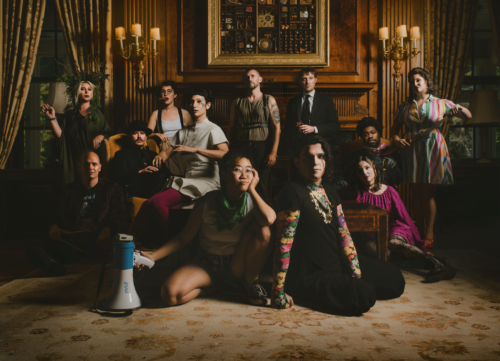
Roomful of Teeth (voice)
Roomful of Teeth (voice)
Roomful of Teeth is a Grammy Award-winning vocal band dedicated to reimagining the expressive potential of the human voice. By engaging collaboratively with artists, thinkers, and community leaders from around the world, the group seeks to uplift and amplify voices old and new while creating and performing meaningful and adventurous music using a continuously expanding vocabulary of singing techniques.
Roomful of Teeth has built a significant and ever-growing catalog of music through deep collaboration with a broad range of composers including Julia Wolfe, David Lang, Missy Mazzoli, William Brittelle, Angélica Negrón, inti figgis-vizueta, Paola Prestini, Nathalie Joachim, Caroline Shaw, Leilehua Lanzilotti, Anna Clyne, Sarah Kirkland Snider, Cava Menzies, Judd Greenstein, Terry Riley, Toby Twining, Ted Hearne, Eve Beglarian, Caleb Burhans, Ambrose Akinmusire, Michael Harrison, Peter S. Shin, and Jerod Impichchaachaaha’ Tate.
Recent appearances include performances at Carnegie Hall, Lincoln Center, Kennedy Center, Walt Disney Concert Hall, King’s Place in London, and the Barbican. The group has also performed commissioned works for Roomful of Teeth and orchestra with the New York Philharmonic, Los Angeles Philharmonic, Seattle Symphony, The Cabrillo Festival Orchestra, Cincinnati Symphony Orchestra, the BBC Symphony, and others, and have also moved into stage work with the visionary opera director Peter Sellars in Claude Vivier’s opera Kopernikus.
Roomful of Teeth discography includes their eponymous first album, released in 2012, which was awarded a Grammy Award for Best Chamber Music/Small Ensemble Performance, and featured Roomful of Teeth member Caroline Shaw’s Pulitzer Prize winning piece Partita for 8 Voices. Other recordings include: Render (2015), The Colorado (2016), Yo-Yo Ma’s Silkroad Ensemble’s album Sing Me Home which won the 2016 Grammy for Best World Music Album, and 2 EPs: The Ascendant (Wally Gunn) and Just Constellations (Michael Harrison). Teeth‘s recordings have been featured on television and in film, including Josephine Decker’s Madeline’s Madeline, Netflix’s Dark, Jeen-Yuhs: A Kanye Trilogy, and Homecoming: A Film by Beyoncé.
Their latest album, Rough Magic (New Amsterdam Records, 2023) was captured using groundbreaking recording techniques and innovative spatial technology. Roomful of Teeth was recognized at the 66th GRAMMY awards in 2024, winning Best Chamber Music/Small Ensemble Performance for Rough Magic; and composer William Brittelle’s work Psychedelics, which appears on Rough Magic, was nominated for Best Contemporary Classical Composition.
Roomful of Teeth is devoted to creating beauty and community with passionate curiosity, contagious enthusiasm, and deep gratitude. Visit www.roomfulofteeth.org

Astrid Schween (cello)
Astrid Schween (cello)
Cellist Astrid Schween has gained a rich following and enjoys a varied career as a soloist, chamber artist and teacher. Since joining the Juilliard String Quartet in 2016, she has appeared at Amsterdam’s Concertgebouw, the Musikverein in Vienna, the Berlin Konzerthaus, London’s Wigmore Hall, Yamaha Hall in Tokyo, and in Hong Kong, Singapore, Greece, China, Spain, Scandinavia and throughout the US, with concerts at the Lincoln Center Chamber Music Society, New York’s 92nd Street Y, Ravinia, Tanglewood and the Kennedy Center. With degrees from the Juilliard School, Astrid Schween received her training under the guidance of Leonard Rose, Harvey Shapiro, Bernard Greenhouse, Ardyth Alton and Dr. H.T. Ma, and was mentored as a young cellist by Jacqueline Du Pré and Zubin Mehta. She participated in the Marlboro Music Festival, the William Pleeth Cello Master Classes in Aldeburgh and made her debut at the age of 16 with the New York Philharmonic.
This season, Astrid Schween appears as soloist-special guest artist at the Violoncello Society of New York, Seattle Chamber Music Festival, Cleveland Cello Society, Gather NYC, Aronson Cello Festival, in Minneapolis at the 20th Biennial Suzuki Association of the Americas Conference, and at the Metropolitan Museum of Art to host a special event in honor of the Guarneri String Quartet. Last season, her solo engagements took her around the US, with a performance of the Elgar Concerto in Boulder, CO, and recitals and master classes at the Boston Conservatory, the University of Maryland, Smith College, the Four Seasons concert series in Oakland, CA and Friends of Music in Kalamazoo, MI. Previously, she appeared as soloist with the Memphis Symphony and at the Peninsula, Interlochen and Sewanee festivals. In recent seasons, Astrid Schween was featured in Strings and Strad magazines, on National Public Radio, and was a guest speaker on Women in Music at the Library of Congress. She appears regularly on Classical music internet platforms such as “Living the Classical Life,” The Violin Channel and CelloBello. Her current collaborations include frequent appearances at the Seattle Chamber Music Festival, recitals with pianists Victor Asuncion, Randall Hodgkinson and a soon-to-be-released CD of Romantic cello sonatas with pianist Michael Gurt. She recently recorded Rhapsody for Cello and Electronics with her husband, composer Gordon Green, and a highly acclaimed album with The Boston Trio. Recent collaborative releases appear on the Sony, Centaur and JRI labels.
Astrid Schween is a member of the cello faculty at Juilliard and the Perlman Music Program on Shelter Island. She was for many years on the faculty at Interlochen, the University of Massachusetts Amherst, Mount Holyoke College and the Hartt School of Music. She was also cellist of the Boston Trio, a frequent guest with the Boston Chamber Music Society and a longtime member of the Lark Quartet, with whom she earned the Naumburg Chamber Music Award, appeared at Carnegie Hall, Lockenhaus, the Schleswig-Holstein Festival and other prestigious venues. Additional recordings appear on the Arabesque, Decca/Argo, New World, CRI and Point labels. She is represented by Thomas Gallant of General Arts Touring.

Mark Shapiro (conducting)
Mark Shapiro (conducting)
Six-time ASCAP Award-winner Mark Shapiro is active as a conductor of choruses, orchestras, and opera. He is Music Director of The Cecilia Chorus of New York, Artistic Director of Cantori New York, Principal Conductor of Marshall Opera, and Conductor Emeritus of The Prince Edward Island Symphony Orchestra, which he served as Music Director for a decade. Characterizing his leadership as “insightful,” The New York Times has praised his “virtuosity and assurance”; Opera News has noted his “superb pacing and great confidence.” Favorite venues include Carnegie Hall, where Shapiro has conducted more than 25 performances; Lincoln Center, Le Poisson Rouge, the Guggenheim and Rubin Museums, Charlottetown’s Confederation Centre of the Arts, and the amphitheater at Vaison-la-Romaine, France.
Opera credits include five productions with Juilliard Vocal Arts and appearances with American Opera Projects, Center for Contemporary Opera, Encompass New Opera, Opera Company of Middlebury, and Underworld Opera, as well as the opera programs of Hofstra, Mannes, and Rutgers. Stage directors include Ed Berkeley, Mary Birnbaum, John Giampietro, Crystal Manich, Louisa Muller, and Emma Griffin.
Shapiro has recorded for Albany, Arsis, Newport Classics, and PGM, and released albums on Naxos and Parma/Navona in 2025. His recording of Frank Martin’s oratorio Le vin herbé was an Opera News Editor’s Choice. An album of music by Philip Glass with Irish violinist Gregory Harrington and Shapiro conducting the Janacek Philharmonic was released in 2020 and reached the classical charts twice. Radio appearances have included CBC, WQXR, WNYC, Minnesota Public Radio, and Sirius.
Shapiro has been a teaching artist with the Metropolitan Opera’s Lindemann Young Artist Program and teaches conducting at the Juilliard School (Julliard Extension Division), Mannes (The New School), and Teachers College (Columbia). Each summer he directs the conducting program of the European American Musical Alliance in Paris.

Caeli Smith (viola, violin)
Caeli Smith (viola, violin)
Called “intense, precise, and full of personality” after appearing as concerto soloist with The Juilliard Orchestra at Alice Tully Hall (OperaClick), CAELI SMITH is an award-winning chamber musician, educator, and facilitator. She has performed across the United States, Europe, and Asia with the Orpheus Chamber Orchestra, The Knights, Sejong Soloists, Jordi Savall, and the Verbier Chamber Orchestra. Caeli is an alum of Carnegie Hall’s Ensemble Connect, the post-graduate performance, education, and leadership program of Carnegie Hall and The Juilliard School. She is a founding member of Frisson and a member of the dynamic, eclectic chamber group, Sybarite5.
A curious and enthusiastic educator, Caeli is on the faculty of the Heifetz International Music Institute, the Kinhaven Music School, and the New York Philharmonic Teaching Artists. She is a Teaching Assistant and Technique Instructor for the ACHT Viola Studio at The Juilliard School. She has led educational workshops for the fellows of Ensemble Connect and the music teachers of Musical Mentors Collaborative. In 2022-2023 she is the visiting professor of viola, teaching the viola studio at the North Carolina School of the Arts in Winston-Salem.
Caeli holds two degrees from The Juilliard School: a bachelor’s degree in violin performance and a master’s degree in viola performance. Upon graduating, she received the William Schuman Prize for Outstanding Achievement and Leadership in Music. Caeli also holds a Master’s in Education, Leadership, Organizations, and Entrepreneurship; with a concentration in Arts and Learning from the Harvard Graduate School of Education.
Caeli has written for radio, TV, and print, and her articles have appeared in The Philadelphia Inquirer, as well as Strings, Teen Strings, and Symphony magazines.

Minton Sparks (composition, voice)
Minton Sparks (composition, voice)
A wildly original spoken word artist, novelist, teacher, and essayist, Minton Sparks was born in a Tennessee college town and raised among her Southern family in and around Arkansas. Her Spoken Word appearances range from the prestigious Jonesborough National Storytelling Festival all the way to the American Songbook Series at Lincoln Center in New York City, and she recently made a rare spoken word debut at the Grand Ole Opry. She has opened for such totemic souls as John Prine, Nanci Griffith, Rodney Crowell, Punch Brothers, Indigo Girls, and Ben Folds. In 2019, The Fellowship of Southern Writers recognized Minton with their first ever Spoken-Word Award, presented to her by novelist Dorothy Allison.
Minton’s books, Desperate Ransom and White Lightning, and her writing have received wide acclaim from NPR’s Weekend Edition and BBC’s Bob Harris Show. Her performances have captivated audiences across the United States and Europe. Minton’s debut recording on Dualtone Records included a vocal appearance by the legendary Waylon Jennings. Her second recording, This Dress featured a performance by the phenomenal bluesman, Keb Mo’. Her fifth record, Where Humans End and Birds Begin, will be released in June of 2023.
Minton writes songs that aren’t songs, poems that aren’t poems, draws the shape of herself amid grungy percussion, humid guitar, electric murmurs beyond location.
There’s a wild-eyed thing in the middle of what she makes. There’s pain in what she talks about, and so at first you figure that wild-eyed thing is her characters’ pain—girls like bruises on the body of Christ, whipped by bible-thumping mothers, watching their twins drown, tied to stoves. In the middle of a live performance you realize the wild-eyed thing in the middle of what Minton makes is the restless life force of her.
Minton Sparks founded the Nashville Writing and Performance Institute to draw students further into their own stories. In the summer of 2022 she taught her writing workshop, Create Your Story, in both Spain and Portugal.
In December of 2022, Minton, along with ACME Feed and Seed, launched the inaugural Minton Sparks’ Spoken Word and Poetry Festival in Nashville, TN. The 3-day festival featured performances by Minton and other world-class artists and writers including Derrick Brown, Alora Young, JoJo Hermann from Widespread Panic, and Lonnie Holley.

Jesse Strauss (percussion)
Jesse Strauss (percussion)
Jesse Strauss, a percussionist and graduate of Belmont University, specializes in chamber music and improvised music for dance. As an accompanist and performer, he has worked with Nashville based dance companies Epiphany, FALL Dance, Belmont University Dept. of Dance, and Tennessee’s Governor School for the Arts. His experience in these settings focuses heavily on improvisation with hand drums, synthesizers, sound processing, and drones. He has performed solo and chamber music at TEDx Nashville, the Nashville Sideshow Fringe Festival, OZ Arts, Chosen Vale Percussion seminar, Leigh Howard Stevens Marimba seminar, Ijams Nature Center in Knoxville, Princeton’s Unruly Sounds festival, and the Pittsburgh New Music Festival.
Jesse serves as cofounder and organizer of Make Music Nashville, a free day of music that brings outdoor concerts and participatory musical activities to neighborhoods around the city. He also works with various non-profit arts organizations, including the Nashville Symphony Orchestra, and is a strong advocate for Nashville’s local arts scene. His musical influences include Sufjan Stevens, Sondre Lerche, Tristan Perich, Steve Reich, John Cage, Dan Deacon, and Johann Sebastian Bach. When not making music, you may find him cycling around town on his red Peugeot and listening to public radio.

Peter Susser (composition, theory)
Peter Susser (composition, theory)
Peter is a Senior Lecturer at the Columbia University Department of Music, where he’s also served as Director of Undergraduate Musicianship since 2011. He has a long association with Columbia, where he earned his DMA and where he has taught as an adjunct instructor for many years. As a composer and producer, Dr. Susser has been commissioned by a variety of orchestras, ensembles and soloists including the Queen’s Chamber Band, the Sage City and New Amsterdam Symphonies, and Speculum Musicae. He is on the faculties of Columbia University and the American Musical and Dramatic Academy (AMDA). In 1990, Dr. Susser was a resident of the MacDowell Colony. He received his Doctorate in Music in composition from Columbia University and holds a Master’s Degree in cello performance from the Manhattan School of Music, where he won the Pablo Casals Prize and the Ravel Competition. His music is available on Albany and Capstone Records. Dr. Susser is a member of MMC’s Board of Directors, and has served as a pedagogical coach to MMC’s volunteer university music instructors since 2010.

Dan Tepfer (composition, piano)
Dan Tepfer (composition, piano)
One of his generation’s extraordinary talents, Dan Tepfer has earned an international reputation as a pianist-composer of wide-ranging innovation, individuality, and drive—one “who refuses to set himself limits” (France’s Télérama). The New York City-based Tepfer, born in 1982 in Paris to American parents, has recorded and performed around the world with some of the leading lights in jazz and classical music, from Lee Konitz to Renée Fleming, and released eleven albums of his own in solo, duo and trio formats.
Tepfer earned global acclaim for his 2011 release Goldberg Variations / Variations, a disc that sees him performing J.S. Bach’s masterpiece as well as improvising upon it—to “elegant, thoughtful and thrilling” effect (New York magazine). Tepfer’s 2019 video album Natural Machines stands as one of his most ingeniously forward-minded yet, finding him exploring in real time the intersection between science and art, coding and improvisation, digital algorithms and the rhythms of the heart. The New York Times has called him “a deeply rational improviser drawn to the unknown.” His 2023 return to Bach, Inventions / Reinventions, an exploration of the narrative processes behind Bach’s beloved Inventions, became a best-seller, spending two weeks in the #1 spot on the Billboard Classical Charts.
During the Covid pandemic, his belief that music brings people together in times of crisis led him to dive headlong into live-streaming, performing close to two hundred online concerts from his home for a devoted community of listeners. As part of this effort, he pioneered ultra-low-latency audio technology enabling him to perform live through the internet with musicians in separate locations, culminating in the development of his own app, FarPlay.
Tepfer has composed for various ensembles beyond jazz. His piano quintet Solar Spiral was premiered in 2016 at Chicago’s Ravinia Festival, with Tepfer performing alongside the Avalon String Quartet. Tepfer has received commissions from the Prague Castle Guard Orchestra for two works: the suite Algorithmic Transform(2015) and a concerto for symphonic wind band and improvising piano, The View from Orohena (2010). In summer 2019, Tepfer unveiled his jazz-trio arrangement of Stravinsky’s Baroque-channeling Pulcinella. In 2024-2025, he’ll premiere three new major commissions: a suite for choir and piano in memory of his mother, a chorister at the Paris Opera; a song cycle for jazz great Cécile McLorin Salvant and string orchestra; and a symphonic work featuring algorithms and visuals.
Tepfer’s honors include first prizes at the 2006 Montreux Jazz Festival Solo Piano Competition, the 2006 East Coast Jazz Festival Competition, and the 2007 American Pianists Association Jazz Piano Competition, as well as fellowships from the American Academy of Arts and Letters (2014), the MacDowell Colony (2016), and the Fondation BNP-Paribas (2018, 2021 & 2024).

Jeanine Tesori (composition, theatre)
Jeanine Tesori (composition, theatre)
Jeanine won the Tony Award for Best Original Score with Lisa Kron for the musical Fun Home. She has also written Tony-nominated scores for Twelfth Night at Lincoln Center; Thoroughly Modern Millie (lyrics, Dick Scanlan); Caroline, or Change (lyrics, Tony Kushner); and Shrek The Musical (lyrics, David Lindsay-Abaire). The production of Caroline, or Change at the National Theatre in London received the Olivier Award for Best New Musical. Her 1997 Off-Broadway musical Violet (lyrics, Brian Crawley) opened on Broadway in 2014 and garnered four Tony nominations, including Best Musical Revival. Opera: A Blizzard on Marblehead Neck (libretto, Tony Kushner; Glimmerglass) and The Lion, The Unicorn, and Me (libretto, J. D. McClatchy, Kennedy Center). Music for plays: Mother Courage (dir. George C. Wolfe, with Meryl Streep and Kevin Kline), John Guare’s A Free Man of Color (Lincoln Center Theater, dir. George C. Wolfe), and Romeo and Juliet (Delacorte Gala). Film scores: Nights in Rodanthe, Every Day, and You’re Not You. Ms. Tesori is a member of the Dramatists Guild and was cited by the ASCAP as the first female composer to have two new musicals running concurrently on Broadway. She was the founding artistic director of Encores! Off-Center at New York City Center, and a lecturer in music at Yale University. Most of all, she is the proud parent of Siena Rafter.

Tazewell Thompson (directing, opera/theatre, playwriting)
Tazewell Thompson (directing, opera/theatre, playwriting)
Tazewell Thompson is an internationally acclaimed director for opera and theatre, an award-winning playwright, librettist, teacher and actor.
His opera Blue with composer Jeanine Tesori, won the 2020 MCANNA Award for Best New Opera in North America. The New York Times listed Blue as Best in Classical Music for 2019. He has more than 150 directing credits, including 30 world and American premieres, in major opera houses and theaters across the USA, France, Spain, Italy, Africa, Japan and Canada, including Glimmerglass, New York City Opera, Teatro Real, La Scala, L’Opera Bastille, Cape Town, Tokyo, Vancouver and San Francisco Opera. His award-winning play, Constant Star has had 16 national productions, garnering 9 Barrymore Awards, 5 NAACP Awards and 3 Carbonell Awards; Mary T & Lizzy K, commissioned and produced at Arena Stage, is the recipient of The Edgerton Foundation New American Play Award; author of Jam & Spice: The Music of Kurt Weill; an adaptation of A Christmas Carol; and a contributing writer to Our War, short plays for Washington DC. His a cappella musical Jubilee: Fisk Jubilee Singers had its world premiere spring of 2019 and played to SRO audiences at Arena Stage. He has play commissions from Lincoln Center Theatre, South Coast Rep and People’s Light & Theatre Company. His production of Porgy and Bess, broadcast Live from Lincoln Center, received EMMY Award nominations for Best Director, and Best Production: Classical Music. He holds the record for directing three productions: Appomattox/ Philip Glass, Lost in the Stars/ Kurt Weill, and his American premiere production from Glimmerglass Festival of Cato in Utica/ Vivaldi all in the same season in three different theaters at The Kennedy Center. He was chosen to rewrite the libretto and direct the premiere staging of Aaron Copland’s The Second Hurricane as part of a New York State-wide celebration of Copland’s 85th birthday. A select list of operas directed: Dialogues of the Carmelites, Death in Venice, Xerxes, Carmen, Don Giovanni, The Tender Land, Street Scene, Pearl Fishers, Norma, Margaret Garner, A Midsummer’s Night Dream, Patience, Freedom Ride. He is commissioned by Seattle Opera to write a song cycle and his opera Blue is rescheduled for future productions at Washington National Opera, Chicago Lyric, Minnesota Opera and Mostly Mozart Festival. At schools and conservatories, directed productions and held master classes at NYU, Juilliard, Yale, Dartmouth, Columbia, Tulane, Indiana/ Bloomington, and Kansas/ Lawrence. Chair of Theater Department: St. Ann’s School and Columbia Prep.
His national theatre directing credits include nearly every major theatre across the country including: the Public Theater/New York Shakespeare Festival, Roundabout Theatre, Manhattan Theatre Club, Arena Stage, the Goodman, Seattle Rep, Oregon Shakespeare Festival, Cleveland Play House, Hartford Stage, Second Stage, Guthrie, Indiana Rep, Actors Theatre of Louisville, Huntington Theatre, Delaware Theatre Company, Syracuse Stage, Playmakers Rep, City Theatre, Virginia Stage, and the Old Globe.
He is a member of SDC, SAG, AFTRA, AEA, AGMA and CAE.

Qiang Tu (cello)
Qiang Tu (cello)
Chinese-born cellist Qiang Tu enjoys a multi-faceted career as a performer, teacher, and advocate for classical music. Now in his third decade as a member of the New York Philharmonic, he has also concertized as a soloist, recitalist, and chamber musician in Australia, Belgium, China, France, Germany, Italy, Japan, South Korea, Switzerland, Taiwan, and the United Kingdom. In the United States he has performed at major venues in New York, Chicago, Los Angeles, St. Louis, Honolulu, and Princeton. He has shared the stage with numerous distinguished artists including pianists Garrick Ohlsson, Jean-Yves Thibaudet, and Lukas Foss; former New York Philharmonic Concertmaster Glenn Dicterow; and former Principal Clarinet Stanley Drucker. As a recording artist, Mr. Tu has released multiple solo albums on the China Record Corporation label and chamber music recordings on the Bridge Records, Cala Records, and EMI labels. A dedicated teacher, he is a member of the orchestral performance faculty at the Manhattan School of Music; early in his career he taught at the Beijing Central Conservatory.
Qiang Tu was raised in a musical family and began cello studies with his father, Zeguang Tu. He holds a bachelor of arts degree from Beijing Central Conservatory and a master of music degree from Rutgers University. He is an alumnus of the Music Academy of the West. His major cello teachers have included Bernard Greenhouse, Zara Nelsova, and Paul Tortelier.
When not at work Mr. Tu is a gourmet chef and enjoys the study of rare Chinese art.

Suzanne Vega (voice, songwriting)
Suzanne Vega (voice, songwriting)
Widely regarded as one of the foremost songwriters of her generation, Suzanne Vega released her latest album, An Evening of New York Songs and Stories, on September 11, 2020 (Amanuensis/Cooking Vinyl). “I recorded these songs at the Café Carlyle in New York City,” Vega says of the album. “It’s a small, exclusive club that has hosted legends from Eartha Kitt to Judy Collins, and is also known to be the place where Jackie Kennedy met Audrey Hepburn. I love it for its bohemian old-world glamour! I included songs that were inspired by New York City or for which New York provided the backdrop, including “Walk on the Wild Side” by my late, great friend, Lou Reed—a song I rarely heard him sing himself.”
An Evening of New York Songs and Stories finds Vega backed by longtime guitarist and musical director Gerry Leonard, bassist Jeff Allen and keyboardist Jamie Edwards. Produced by Leonard, mixed by Grammy Award-winning engineer Kevin Killen and mastered by Grammy Award winner Bob Ludwig, the album was recorded in early 2019 and includes familiar songs like “Luka” and “Tom’s Diner” and deep cuts from Vega’s catalog including “Frank and Ava” and “Ludlow Street.” The mix of repertoire also features “New York Is My Destination” from Lover, Beloved: Songs from an Evening with Carson McCullers, Vega’s 2016 album from her one-woman play about the Southern gothic novelist Carson McCullers.
Vega emerged as a leading figure of the folk-music revival of the early 1980s when, accompanying herself on acoustic guitar, she sang what has been called contemporary folk or neo-folk songs of her own creation in Greenwich Village clubs. Since the release of her self-titled, critically acclaimed 1985 debut album, she has given sold-out concerts in many of the world’s best-known venues. Known for performances that convey deep emotion, Vega’s distinctive, “clear, unwavering voice” (Rolling Stone) has been described as “a cool, dry sandpaper-brushed near-whisper” by The Washington Post, with NPR Music noting that she “has been making vital, inventive music” throughout the course of her decades-long career.
Bearing the stamp of a masterful storyteller who “observes the world with a clinically poetic eye” (The New York Times), Vega’s songs have tended to focus on city life, ordinary people and real-world subjects. Notably succinct and understated, her work is immediately recognizable—as utterly distinct and thoughtful as it was when her voice was first heard on the radio over 30 years ago.
Vega was born in Santa Monica, CA, but grew up in Spanish Harlem and the Upper West Side of New York City. She was influenced by her mother, a computer systems analyst and her stepfather, the Puerto Rican writer Egardo Vega Yunque. There was a heady mix of multicultural music playing at home: Motown, bossa nova, jazz and folk. At age 11 she picked up a guitar and as a teenager she started to write songs.
Having studied dance at the High School for the Performing Arts, Vega later attended Barnard College where she majored in English Literature and minored in theater. In 1979, after attending a concert by Lou Reed, she began to find her true artistic voice and distinctive vision for contemporary folk. A receptionist by day, she would hang out at the Greenwich Village Songwriter’s Exchange by night. Soon she was playing iconic venues like The Bottom Line and Folk City—the word was out and audiences were catching on.
At first, record companies saw little prospect of commercial success. Vega’s demo tape was rejected by every major record company—and twice by the very label that eventually signed her. Her self-titled debut album (A&M) was finally released in 1985, co-produced by Steve Addabbo and Lenny Kaye, guitarist for Patti Smith. One million records later, it was clear that Vega’s voice was resonating around the world. “Marlene on the Wall” was a surprise hit in the U.K. and Rolling Stone eventually included the record in their “100 Greatest Recordings of the 1980s.”
1987’s follow-up, Solitude Standing—again co-produced by Addabbo and Kaye—elevated her to star status. The album hit #2 in the U.K. and #11 in the States, was nominated for three Grammys (including Record of the Year) and went platinum in the U.S., selling three million copies worldwide. “Luka” is a song that has entered the cultural vernacular—likely the only hit song ever written from the perspective of an abused boy. Vega continues to support children’s and human rights groups such as Amnesty International, Casa Alianza and Covenant House.
The opening song on Solitude Standing was an a cappella piece, “Tom’s Diner,” about a nondescript restaurant near Columbia University. Without Vega’s permission, it was remixed by U.K. electronic dance duo DNA and bootlegged as “Oh Susanne.” Suddenly Vega’s voice was showing up in the most unlikely setting of all: the club. She permitted an official release of the remix of “Tom’s Diner” under its original title, which reached #5 on the Billboard pop chart and went gold. In 1991, she brought the remix and other unsolicited versions of the song together in a compilation called Tom’s Album. Vega also holds the distinction of being christened “Mother of the MP3” by the technology’s creator, who used her recording of “Tom’s Diner” to refine its compression algorithm.
Vega co-produced her follow-up album with Anton Sanko, 1990’s Days of Open Hand. The album featured a string arrangement by composer Philip Glass, for whose song cycle Songs from Liquid Days she had penned lyrics years earlier. Continuing to battle preconceptions, she teamed with producer Mitchell Froom for 1992’s 99.9F, the sound of which instigated descriptions such as “industrial folk” and “techno folk.” Certified gold, 99.9F won a New York Music Award as Best Rock Album. Vega was also the first of an elite group of women, joined recently by Billie Eilish, to land three consecutive singles in Billboard’s Alternative Top 10, beginning with “Book of Dreams,” followed by her featured spot on DNA’s “Tom’s Diner” and concluding with her own “Blood Makes Noise.”
In 1996, Vega returned with the similarly audacious Nine Objects Of Desire, also produced by Froom, who by then was her husband. Over the years, she has been heard on soundtracks including Pretty In Pink (“Left Of Center” with Joe Jackson) and contributed to such diverse projects as the Disney compilation Stay Awake, the Grateful Dead tribute Deadicated and the Leonard Cohen tribute Tower Of Song. In 1999 The Passionate Eye: The Collected Writings Of Suzanne Vega, a volume of poems, lyrics, essays and journalistic pieces, was published by Spike/Avon Books. In 2001, she returned to her acoustic roots for her first new album in five years, the critically lauded Songs In Red And Gray.
In 2007, Vega released the Grammy award-winning Beauty & Crime on Blue Note Records, a deeply personal reflection of her native New York City in the wake of the loss of her brother Tim Vega and the tragedy of 9/11. Vega’s love for the city shines through as both its subject and its setting, and she mixes the past and present, the public with the private, and familiar sounds with the utterly new—just like the city itself.
Recently Vega was a member of the cast of the Off-Broadway production of Bob & Carol & Ted & Alice. The New York Times said of her performance, “As our polymorphic host, the brandy-voiced Vega…is a delightful, smoothly sardonic presence…a discreetly entertaining font of omniscience.”
Jay Vilnai (composition)
Jay Vilnai (composition)
Jay Vilnai‘s musical journey owes to a unique heritage as a Russian-Romanian-Polish descendant raised in Jerusalem around a mix of contemporary and traditional Jewish and Arab music, with a soul for rock n’roll a BFA in jazz and an MM in concert composition. He pursued guitar studies at the New School Jazz and Contemporary Music Program in New York in 2000, where he graduated with honors in 2003, followed by composition studies at Brooklyn College where he received the John Cage Award for excellence in Composition.
Vilnai has performed with Matt Darriau’s Paradox Trio, Aaron Alexander’s Midrash Mish Mosh, Romashka, as well as other ensembles, and has shared the stage with diverse figures such as trumpeter Frank London, balafon player Famoro Dioubate and the Phoenix Symphony. He served as musical director of the off-Broadway show Nice Jewish Girls Gone Bad and as guitarist for several shows, including the cast album of Next Thing You Know. He has been commissioned to write works for the Metro Chamber Orchestra, Brandy Trio, ai ensemble, trombonist Jen Baker, trombonist David Whitwell and video artist Elizabeth Hamby. His compositions have been performed around the country, most notably by CUNY’s CME, OMNI Ensemble and others. His 2011 release ‘Shakespeare Songs’, featuring the MIVOS quartet and singer Gelsey Bell was said by Lucid Culture to possess ‘creepy otherworldliness’, and ‘ghostly ambience’. Vilnai has led ‘Vampire Suit’, an improvising chamber quintet that combines his interests in Balkan music with contemporary, detailed chamber writing. The ensemble has released two recordings to positive reviews, said to have ‘enduring beauty’ (Cadence Magazine), called ‘Bram Stoker’s Transylvania jazz scene‘ (jazzreview.com), and said to posses an ‘airy, festive, free-form atmosphere’ (download.com, editor’s pick).
In addition to his work as a performing and composing musician, Vilnai is an active music teacher, an activity he pursues out of conviction that arts education is a responsibility and a mission for any active artist. At the New School he studied music education as an elective. He teaches guitar, composition and theory privately to students of a wide gamut of ages and abilities, from beginning children to college students to amateur adults. From 2003-2006 he was guitar teacher for the non-profit Harmony program. In the years following his graduation from Brooklyn College he has substituted as a teacher there for both college and high school classes for topics ranging from theory, music history, music technology, introduction to music and more and has taught at Uncommon Schools and at NYC public schools through the Brooklyn Conservatory of Music. As a teacher, Vilnai draws on his knowledge of a plethora of styles and traditions to stimulate and engage students and to draw connections between disparate genres, highlighting the similar throb that lies in all artistic expression.

Stephen Wadsworth (directing, opera/theatre)
Stephen Wadsworth (directing, opera/theatre)
Stephen Wadsworth, a native New Yorker, is the James S. Marcus Faculty Fellow and the director of the Artist Diploma in Opera Studies program at Juilliard. He is an adjunct professor of directing at Columbia University School of the Arts, and a long-time Master Teacher in the Metropolitan Opera’s Lindemann Young Artist Development Program. Mr. Wadsworth has directed opera at the Met, La Scala, Covent Garden, Vienna State Opera, Netherlands Opera, Edinburgh Festival, San Francisco Opera, as well as many others, and plays on and off Broadway, in London’s West End, and in U.S. regional theater. He wrote A Quiet Place with Leonard Bernstein, and The Flood with Korine Fujiwara, and is the author of Marivaux: Three Plays and Moliere/Wadsworth: Don Juan (published by Smith and Kraus). He recently translated and directed the first two Beaumarchais Figaro plays—Le Barbier de Séville and Le Mariage de Figaro. He was named Chevalier de l’Ordre des Arts et des Lettres by the French government, and is a Creative Advisor for the Sundance Institute Theatre Program. He received Juilliard’s Erskine Faculty Prize in 2009.
Chris Webb (songwriting)
Chris Webb (songwriting)
Chris Webb has been playing the guitar, singing and writing music for over 25 years. Music is his passion, and his outlet for expression and creativity. Chris uses a unique songwriting style infused with complex chords and intricate melodies to reach his listeners and draw them in. Chris loves strumming his guitar for listeners at all types of venues and events.
Chris earned a Bachelor of Arts in Music from the University of Colorado-Boulder, and has since released several albums of original material and toured the country playing from city to city. Currently, Chris performs at public and private events, always receiving rave reviews from clients. Chris also passes on his musical passion through teaching at the University of Colorado-Denver.
Chris has shared the stage with many talented musicians, from Sister Hazel to Louden Wainwright, and also develops music for the television and film industry. He is always looking for new opportunities to co-write, collaborate and expand his musical endeavors. Chris’s ultimate focus is his love for music.
Alex Weston (composition, piano)
Alex Weston (composition, piano)
Alex Weston is a composer for concert works and film scores. Notable recent film scores include The Farewell (dir: Lulu Wang, A24), which was included on the shortlist for “Best Original Score” for the 2020 Academy Awards, Expats starring Nicole Kidman (dir. Lulu Wang, Amazon), Wander Darkly (dir: Tara Miela, Lionsgate), The Novice (dir: Lauren Hadaway, IFC), Goodnight Mommy (dir: Matt Sobel, Amazon), and The Adults (dir. Dustin Guy Defa, Universal). Weston’s music has also been featured on The Affair (Showtime), Jane Fonda in Five Acts (HBO), the Ken Burns-produced documentary The Emperor of All Maladies (PBS), and various projects for NBC, Netflix, Apple, and other studios.
Alex’s concert works include commissions from groups such as the Lyrica Chamber Music Ensemble, ABCIrque, MADArt Creative, the Kennedy Center, the Venice Biennale, and Obie Award winning theater company ‘Theater in Quarantine’. Another recent project was providing the score for the large scale public art installation “Past Deposits From a Future Yet to Come” (Hubbard / Birchler), which is screening nightly at Waterloo Park in Austin Texas through 2030. Early in his career, he worked as a music assistant to Philip Glass on projects ranging from film scores to Broadway shows. His most recent album of chamber music, entitled “Memory Gaps”, is based on a book of illustrations and short stories by author/artist Cecelia Ruiz, is available on all streaming services now.
Cathleen Whiles (composition, clarinet, flute, piano, saxophone)
Cathleen Whiles (composition, clarinet, flute, piano, saxophone)
Cathleen Whiles has been teaching private lessons to students for over 30 years. She has taught composition, piano, flute, clarinet and saxophone. I have taught students ages 3-75. She has taught classical, jazz and popular styles. She also has taught classes and private instruction at the Community College of Denver for over 25 years including Music Theory, Ear Training, History of Jazz, World Music, Music Appreciation, Music History, and private lessons.